
- SEO copywriting improves your visibility on Google and other search engines.
- 80% of readers stop at the headline if it’s not persuasive enough.
- Optimised content works exceptionally well when combined with link building.
What is SEO copywriting?
SEO copywriting is the practice of increasing the relevance of your content in the eyes of search engines. It’s about striking a balance between content that persuades people to buy products or services and creating content that search engines value. You can use SEO copywriting on:- Product descriptions.
- Website and blog copy.
- Landing pages.
- Service pages.
Statistics that highlight the significance of SEO copywriting
Words have a powerful effect on the human psyche, consciously and subconsciously. According to statistics from Copyblogger, only 20% of your users read beyond the headline, and the other 80% of readers will stop reading the headline if it doesn’t pique their interest. This isn’t a new theory, though, and in fact, it was back in 1963 that the 80-20 headline rule first came into play in a book called Confessions of an Advertising Man by David Ogilvy. Crafting a great headline that captures the reader’s attention is paramount. You also want to make sure your headline is SEO-friendly and persuasive. A call to action is also crucial, and research by HubSpot found that personalised CTAs convert 202% better than non-personalised CTAs. A powerful call to action might be the difference between success and failure for your business. It tells potential customers what you would like them to do, and most of us are swayed by authority figures. So don’t just rely on having a robust, clickable call to action—make sure it’s personalised and specific to your audience.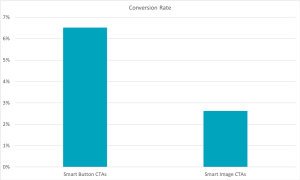 Source
HubSpot’s research analysed more than 300,000 calls to action on different websites and found that more people responded to a personalised version than generic messaging.
Now, try to think of the last time you felt curious about anything — a question you wanted to know the answer to. If you’re like most people, the first thing that came to mind was your handy Google search bar and keyboard. Most online experiences begin with search engines. Creating compelling copy bridges both users and search engines.
Of course, it can be challenging to find these leads without SEO and killer copywriting, but you can if you take the proper steps. Optimising your website and inner pages for search engines increases the chances of people finding you organically, resulting in more qualified customers.
Source
HubSpot’s research analysed more than 300,000 calls to action on different websites and found that more people responded to a personalised version than generic messaging.
Now, try to think of the last time you felt curious about anything — a question you wanted to know the answer to. If you’re like most people, the first thing that came to mind was your handy Google search bar and keyboard. Most online experiences begin with search engines. Creating compelling copy bridges both users and search engines.
Of course, it can be challenging to find these leads without SEO and killer copywriting, but you can if you take the proper steps. Optimising your website and inner pages for search engines increases the chances of people finding you organically, resulting in more qualified customers.
The importance of SEO copywriting
SEO copywriting is the art of writing search engine optimised content that attracts the target audience and reduces bounce rate. It starts with defining the keyword strategy and ends with producing top-quality textual content that complies with search engine optimisation standards.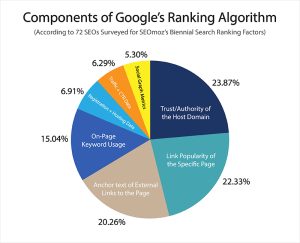 Image credit: Neil Patel
1. Enhances your rankings
SEO copywriting is all about giving your website the best shot at showing up on the first page of Google search results, ensuring you differentiate your business from others through the content. Google’s algorithm will consider you an “authoritative” source if more people engage with your content.2. Increases your website traffic
Using the proper SEO techniques to improve your search rankings can help you gain a more prominent voice. By increasing your brand recognition, you’ll be able to attract more customers to your business and convert them into loyal customers. Ultimately, how well your business performs depends on the amount of traffic you receive per month to grow. When multiple people worldwide are reading about your products and services online, it helps promote more success in the future.3. Provides helpful answers to problems
Creating valuable content around your business, for example, questions and answers using long-tail keywords helps identify potential problems that customers face and provide solutions to these problems.4. Converts traffic
SEO copywriting techniques like short paragraphs and semantic headings catch your reader’s attention and tell them how you can help and why yours is the best service, especially when presenting your products.5. Earns backlinks
When your content engages and intrigues people, they are likely to share it on social media platforms, which brings more traffic and gains backlinks to your site. The belief is that the targeted external links pass value to your website, and site ranking may increase. However, the main benefit of creating accurate quality content should be recognition and popularity rather than increased web rankings — pointing customers toward your enterprise by establishing itself as a reliable authority in its field, which means more sales.An example of SEO copywriting
Moz tested small SEO copywriting changes on their best-ranking site pages and found that after simply adding three simple tweaks, they saw an increase of 32% in organic traffic. Their writing tweaks included:- They added heading tags to enhance page architecture, crawlability, and readability, which resulted in a 14% boost in their traffic.
- They modified their H1 tags with high-traffic volume keywords, boosting their traffic by 9%.
- Hubspot enhanced its visual appeal of pages, which saw a 9% boost in its traffic.
SEO copywriting strategies
Writing articles with the right SEO strategies and engaging content can help you rank your websites and blogs. Here are some things you need to keep in mind.1. Follow the three Cs of search intent
Search intent is the reason a user searches in the first place. For example, let’s say someone searches for “wired headphones.”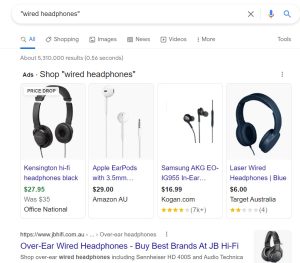 Google only shows you the eCommerce pages when you submit the search query. Because it assumes the user intends to buy the product.
In another case, let’s use the keyword “best wired headphones.”
Google only shows you the eCommerce pages when you submit the search query. Because it assumes the user intends to buy the product.
In another case, let’s use the keyword “best wired headphones.”
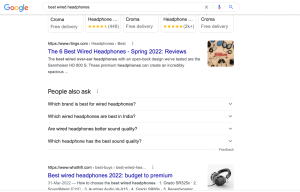 The results are blog posts because the user intends to learn about the product rather than buy it. When creating persuasive content, you should focus on matching the user’s search intent. You can do this by following these three Cs:
- Content-type: Content types can be either long-form or short-ish. Some standard content formats include blog posts, product descriptions, category lists, landing pages, and videos, among other things.
- Content format: Format applies primarily to informational content. Example formats include instructional articles, listicles, opinion pieces, reviews, and news articles.
- Content angle: The content angle is the most crucial aspect of your post. Thus, you must write from a perspective when starting your blog with the intent to earn organic traffic.
2. Implement the ASMR formula
When readers land on your website, they’re giving you their time, and if you want them to stick around, you need to make sure you’re entertaining or educating them. If your content is mundane, they’re more likely to exit the page and your site. Ensure your valuable content is portrayed professionally with the ASMR rule:- Annotating could be helpful as it helps break up the flow of the post; remember not to make your content too large or picture heavy otherwise, your readers might have a more challenging time reading.
- Short sentences, paragraphs, and list items. Long sentences and paragraphs produce a hard-to-follow narrative. Find instances where you used transitional words like “and,” “because,” or “whereas.” Then, break these into shorter statements with less complex connections and fewer words.
- Multimedia. It’s essential to include images and GIFs wherever possible, as they add life to websites. Having more of these will also reduce the amount of text you have to write and will help improve SEO values.
- Read your copy out loud to make sure it flows smoothly. One way to accomplish this is by reading it aloud because sometimes our eyes read words a lot more quickly than we hear them spoken aloud.
3. The APP method by Brian Dean
There’s no denying Brian Dean’s articles are among the most well-written on the web today. And yes, there is a strategy behind this. He has one main format for writing an outstanding introduction, which he calls this strategy the APP method. It stands for:- Agree.
- Promise.
- Preview.
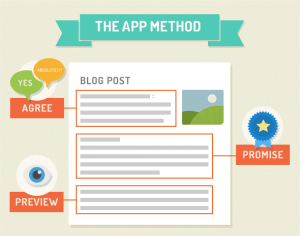 Image credit: Matthew Woodward
First, write a paragraph a reader will agree with. Then outline a promise. Then, tell them how you’re going to achieve it with a preview that shows what you will do.
Image credit: Matthew Woodward
First, write a paragraph a reader will agree with. Then outline a promise. Then, tell them how you’re going to achieve it with a preview that shows what you will do.
4. Target featured snippets
Featured snippets are highlighted pieces of text that appear at the top of a Google search results page, giving a quick answer to what a person searched for. When a user performs a search query, Google provides a quick answer from a larger article. Here is an example of a featured snippet, which shows:- A text answer.
- An image of Adam Smith.
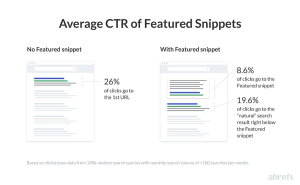
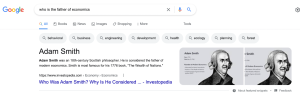 According to CodeFixer, these pages get 8.6% of the total clicks in the search results.
 Source
You can place these answers anywhere in the article. However, if you include a short answer below the subtopic area, this increases the chances for a page to rank as a featured snippet.
It is important to note that the location alone is not the only determining factor — it may also come down to the strength of your domain rating (DR) and the quality backlinks you have built to this page.
Source
You can place these answers anywhere in the article. However, if you include a short answer below the subtopic area, this increases the chances for a page to rank as a featured snippet.
It is important to note that the location alone is not the only determining factor — it may also come down to the strength of your domain rating (DR) and the quality backlinks you have built to this page.
5. Create a seductive title and meta description
You may have a 2,000-word lengthy blog post covering all the targeted keyword information, but people will choose to click on headlines that catch the reader’s attention. A good headline will have three elements:- Keywords.
- It sets an expectation in the reader’s mind.
- It tempts the reader to click and read.
- Be persuasive.
- Induce curiosity.
- Match the search intent.
The advantages of SEO copywriting
- Increases website traffic.
- Generates backlinks, which boosts your domain authority (DA), and increases your organic search rankings.
- It’s a repeatable, scalable process.
- It helps service pages, product pages, and blog pages rank better as they tend to cover around 80-120 micro semantic keywords.
- Boosts your overall digital marketing strategy.
The disadvantages of SEO Copywriting
- Creating a balance between optimised copy, brand, and tone of voice.
- Without quality link building, it can take time to rank for keywords.
- If your domain rating (DR) is relatively low (I.e. less than DR 20), it will require more link building to make this strategy work.
- Content over-optimisation, aka keyword stuffing (when implemented poorly).
- It is hard to find writers that can handle optimised copy content briefs.
SEO Tools for SEO Copywriting
Ahrefs
Ahrefs’ keyword tools for making content creation more efficient. It has standard SEO features that analyse top-performing sites and suggest keywords, site auditing, and rank tracking. It also has essential features for writers like the Content Explorer, which analyses top-performing content in your niche. Semrush’s Keyword Magic Tool is an alternative to Ahrefs, which is excellent for finding the search volume, user intent, and CPC.Yoast
Yoast’s is a WordPress plugin that helps users optimise their content. With this plugin, writers will ensure their writing is easy to read and eye-catching on search engine results pages. The Yoast SEO WordPress Plugin will check your content regularly. If there are potential problems with your SEO optimisation, it’ll bring them to your attention where you can then solve them and reevaluate the quality of your content writing once more.StoryChief
StoryChief is a platform where you can assign, distribute, create and streamline content publishing, and manage and optimise your marketing efforts within your team. It also monitors the keyword density, meta description length, links, etc.Grammarly
Grammarly Premium is an excellent tool for checking grammar. One thing to note is that search engines prefer content to use active voice over passive voice — and Grammarly Premium points this out. It’ll also highlight areas to condense for readability and it is a must-have tool for SEO writing.Surfer SEO
Surfer SEO uses a combination of machine learning, artificial intelligence (AI), and data scraping to create suggestions that you can make to assess pieces of content, their ranking factors, relevant keywords, and keyword intent. The software can show you why particular pieces of content rank and offer meaningful suggestions on how to improve your body copy, provide recommendations on internal links, connect to Google Analytics, provide insights into content that ranks, plus more. There are many other alternatives to Surfer SEO, including Jasper, MarketMuse, Frase, and Clearscope.Key considerations
No matter what kind of SEO copywriting strategy you take, getting started is the main thing. The ROI generated from SEO copywriting will differ across different industries. As an overall strategy, it is pretty valuable, and here are some key things to consider:- Scalability: The strategy can be rolled out across 100s of pages within a relatively short period.
- Domain rating: A higher domain rating will yield results faster.
- Link building: The strategy works exceptionally well with link building, but it may not work without it.
- Competition: If your industry is relatively competitive or highly competitive will have a direct impact on your results.
- Costs: The cost of updating individual articles with SEO optimised content, keyword research, and link building.
Writing content that wins featured snippets, knowledge panels, and AI Overviews
These three surfaces reward different signals, so a single piece of content needs to be structured for all of them rather than optimised for just one. For featured snippets: answer the target question in 40-60 words directly under the heading that matches the query, before adding supporting detail. For knowledge panels: consistent entity information (business name, description, founder, services) repeated identically across your site and third-party profiles (LinkedIn, Google Business Profile) helps Google resolve who you are with confidence. For AI Overviews and LLM answers: the same direct-answer-first structure works, but add a short FAQ block addressing the question’s natural variants, since AI systems pull from whichever passage most precisely matches the phrasing of the prompt. A single well-structured page (direct answer, supporting depth, FAQ section) can be pulled into all three surfaces simultaneously; you don’t need three separate versions.
Summing up
SEO copywriting is a great strategy to get results faster by using semantic keywords related to your primary keyword. Once you get on to page 1, you’ll naturally earn yourself organic links. Ahrefs refers to this as the “vicious circle of SEO”, and according to their analysis, top pages earn dofollow backlinks at 5-14.5% every month. Creating optimised content is a difficult task to do. It often entails scraping the top 9 pages on Google search for the main keyword, plus a semantic keyword, and compiling all of this data into around 80-120 micro keywords. Then, reverse engineering these micro keywords to create better content than what is already ranking on page 1. But when done right, optimised SEO copy can perform wonders, especially if you’re designing the copy for your users and Google. When optimised content is combined with link building, it can be a serious force to be reckoned with.Earned Media SEO copywriting solutions
At Earned Media, we understand the importance of great content, and we know how SEO copywriting can help you get ahead of the competition. We get results by using a 3-step formula that consists of:- Improve technical SEO.
- Create optimised content.
- Build links to the optimised content.
- WordPress web design.
- Custom web design.
- How long does it take to charge a tesla?
- Buying a tesla in Australia.
- Socially responsible investing.
- KYC.
- Micro investing.
- Discretionary income.
- Refinancing personal loans.
- Average credit card debt Australia.
- Am I responsible for my spouse’s debt in Australia?
- How to transfer assets into a family trust in Australia?
- Open banking.
- How to become a waxer?
- How long does it take to become a nail tech?
- Untapped eCommerce niches.
- Grazing table ideas.
- Plus a lot more …