32 min read✓ Fact checked✓ Anti-Plagiarism · 99% Human
Published: 24 August 2022 · Last updated: 24 November 2025 @ 12:42 am
It takes a lot to be successful in the link building space. You need to be great at outreach, building relationships, writing copy, coming up with creative content angles, and being able to identify and leverage link building opportunities. Luckily, all of these skills can be learned with the proper training.
In this guide, I’ll walk you through everything you need to know so you can transition from being a beginner to an advanced link builder. I’ll even share a few of my link building secrets and give you fresh insight into the world of link building. This is what you’ll learn throughout the guide:
Preamble
Earned Media is an SEO-only agency based in Australia. We’ve built quality links from big sites, including Monday SnackNation, Redfin, HubSpot, The Next Web, and many more. We strongly believe in:
Linking to quality content (e.g., linkable assets, blog pages) related to a north star keyword(s).
Acquiring both nofollow and dofollow links.
Acquiring niche industry links.
Link building takes up a lot of our time here at Earned Media. Many friends and businesses have asked us for one-on-one consultations on our link building process. We decided to decline these invitations and distil the most valuable lessons we’ve learned into a link building playbook that all companies can use.
Before getting to the good stuff, remember that link building is complex. It’s a very demanding and results-oriented process that can be quite mentally draining.
Most link builders start the same way. They’ll pitch articles with links with heavy keyword anchor text, format articles incorrectly, and make many mistakes. If a link builder fails to understand what they’re doing wrong, they’ll face a lot of rejections and likely give up early on in the game.
Successful link building requires a bit of hustle, personality, and perseverance. In this guide, you’ll learn from personal, first-hand experiences that could reshape everything you know — or thought you knew — about link building.
Part 1: Link building basics
What is link building?
Link building is the process of obtaining links to a website to improve its search engine ranking and visibility. In SEO, link building is an essential aspect of off-page optimisation. Gaining quality links from authority websites helps brands achieve better SERP (search engine results page) rankings.
Link building can be classified into three categories:
Black hat: Links achieved using unnatural link building techniques.
White hat: Natural links that follow Google’s Webmaster Guidelines.
Grey hat: Blurs the line between white and black hat link building — meaning it’ll be up for debate in the SEO community.
Why is link building important?
Link building is fundamental to every SEO strategy and is essential for ranking your pages higher in SERP. Google’s Andrey Lipattsev stated that links fall within the top three major ranking factors, so they should never be ignored. Some of the benefits of link building include:
Increasing domain reputation and trust: Link building helps increase the authority and trust of your domain in the eyes of search engines, leading to more traffic and customers.
Improving business relationships: Link building outreach can improve relationships between your business and other businesses, creating more opportunities for collaboration and partnerships.
Increasing rankings on money keywords: Authoritative links can increase website rankings on your primary target keywords, helping companies increase profits.
Increasing referral traffic: With more links, you’ll get more referral traffic, as people have more ways to discover your content.
What do the statistics say?
Building links is integral to any SEO strategy and can improve your website’s rankings. Search engines consider backlinks an essential ranking signal determining a web page’s relevance and importance. Here’s what the numbers say:
Websites with more links from unique referring domains rank higher than those with fewer unique referring domains. On top of that, a whopping 96.55% of online pages on the web receive no traffic because they don’t have any backlinks.
Approximately 65% of marketers worldwide believe link building is the most challenging part of SEO.
Research from Moz shows that blog posts with more than 3,000 words gain more backlinks than posts with less than 3,000 words of content. Listicle content acquires more unique backlinks.
Part 2: Backlink quality checks
Link building quality checks are crucial as they provide a process you can use to qualify and disqualify link targets. A quality check helps to hold you and your team accountable.
A friend of mine recently mentioned that he believes in super powerful links. But he doesn’t believe in bad links as Google ignores them. I’m not sure I entirely agree with him on the latter.
I 100% agree with building super powerful links. I’ve seen some links instantly take a new page from not being indexed on Google to bouncing between pages 2 and 3, ending up on page 1, position 1 on Google Search. All within three months.
But when it comes to bad links, I’ve heard of some sites being impacted, even though it’s pretty rare to hear of a Google penalty. Recently, an entrepreneurship blog had to rebrand and start over again while doing black hat SEO. This would have cost the blog thousands of dollars for whatever mistake(s) they made.
Some sites may also strip links from their pages or be unwilling to link to a page due to the site’s spam score. Here are some examples:
Example 1, Guest posts: A link builder pitches a blog with a guest post. The site accepts and publishes the content but removes a link due to the site’s high spam score.
Example 2, Niche edits (also known as link inserts): A link builder conducts a niche edit outreach campaign. But a site is unwilling to link to a specific page because of the site’s spam score.
Bad links eat into a company’s resources. A brand will spend time, money, and resources acquiring non-impactful bad links and paying people to do work that doesn’t positively impact rankings.
Our link building quality check process
If you don’t have a backlink quality check system, feel free to steal the internal process we developed. Here are the main things we check and look for:
Step 1: A domain rating (DR) check.
Step 2: An organic traffic (OT) check.
Step 3: A spam score (SS) check.
Step 4: A monthly pageviews check.
Step 5: A site search analysis check
Step 6: Topical relevance and contextuality,
Step 7: A nofollow and dofollow link check.
Step 1: A domain rating (DR) check
According to Ahrefs, the domain rating (DR) shows the strength of a target website’s backlink profile compared to others in its database on a 100-point scale.
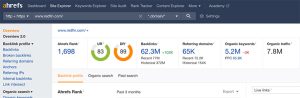
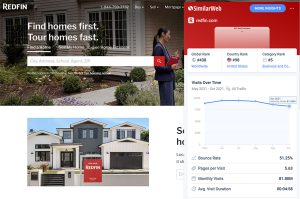
Ahrefs shows that Redfin has a DR of 89, which is relatively high. The DR can vary quite a bit in different industries and regions.
We use the following metrics as a benchmark to maintain consistent quality:
Niche
DR
OT
SS
Home, travel, and lifestyle links.
DR 45+
OT 5K
SS 1%
Business, marketing, and fintech links.
DR 50+
OT 50K
SS 1%
SaaS links.
DR 70+
OT 50K+
SS 1%
Step 2: An organic traffic (OT) check
Organic traffic is an estimation by Ahrefs of how much organic traffic a website receives from Google Search.
We find it invaluable as a metric as it helps to weed out low-quality sites instantly. A site with no organic traffic is either newly created or just a low-quality site selling links.
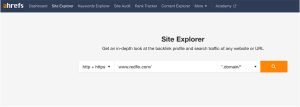
To check organic traffic, go to Ahrefs Site Explorer and enter the website URL you want to check
Click on the orange search button to view the organic traffic (OT). Ahrefs will display the site’s organic traffic, as seen in the example below.
In this example, Redfin gets approximately 7,800,000 in OT, indicating that it could be a valuable link target.
It’s important to note that the OT data from Ahrefs can be inaccurate from time to time. This could be due to a variety of factors, such as:
Ahrefs implementing a software upgrade to their product.
A site intentionally blocking the Ahrefs crawl bot.
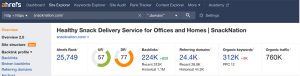
For example, Ahrefs shows that SnackNation (a monster site) has an OT of only 15.
It’s tough to spot when Ahrefs OT data is inaccurate.
If you use a combination of other tools, like Similarweb and BuiltWith, you’ll be able to identify when something like this occurs.
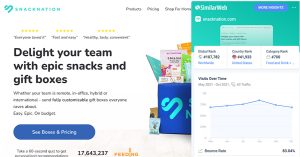
Similarweb shows that SnackNation gets approximately 681,000 monthly page views, a significant discrepancy from the 15 in OT that Ahrefs is showing.
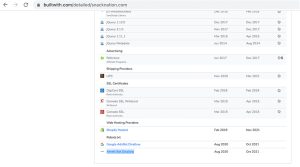
You can dig deeper using BuiltWith by clicking on “detailed technology profile”. You’ll notice that SnackNation is using an “Ahrefs bot disallow,” which prevents Ahrefs from accessing all its website data. This proves that the Ahrefs OT data for SnackNation is inaccurate.
The screenshot we used above of Ahrefs OT discrepancy of SnackNation was taken a few months ago. We rechecked Ahrefs recently, and it now displays the correct OT
This is why you cannot rely on just one indicator sometimes. Instead, use several metrics as a backup whenever your gut tells you there is a data discrepancy.
An additional OT check you can do
Link builders can also check how many keywords a site ranks for in the top 10 search results. If the number of keywords in the top 10 is declining for a few months, it’s a red flag for me.
Step 3: A spam score (SS) check
You can use Website SEO Checker, a free tool that combines data pulled from Moz and Semrush, to aggregate an average spam score (SS) based on link toxicity.
Every site has a minimum SS of 1%. We find this tool quite handy as it can point out sites that may have received a Google penalty (for example, if the SS is in the 33% bracket or higher).
Generally speaking, we’ll reject any site with an SS greater than 1% as a potential link target. In the case of Redfin, it gets a pass.
Simply add the website URL you want to check, type in the reCAPTCHA, and click on Check.
You’ll then be shown the spam score. In this case, it’s 1%, which passes our SEO check.
There are, however, logical exceptions to this.
For example, the Australian Financial Review (AFR) is a prestigious financial news publication with a spam score of 11%. You can see this in the image below.
Most brands would be over the moon to get a link or brand mention on the AFR.
In this case, getting a link from the AFR is fine as it’s a major reputable news site that gets a tonne of traffic.
Step 4: A monthly pageviews check
We use SimilarWeb to highlight any discrepancies that might exist with Ahrefs data. SimilarWeb provides link builders with fast insights into how much web traffic a site gets and can be used to qualify or disqualify a potential link target quickly.
If you’re not already using SimilarWeb, head to their website and download their Chrome extension.
The plugin is free to use and will show you how many monthly pageviews a website gets by clicking on the yin yang symbol.
SimilarWeb also shows other useful information, such as:
A traffic breakdown by country: The data is helpful if you’re looking to explore which regions a site gets the majority of its traffic from.
Traffic sources: Direct, social, email, referrals, and display ads are handy if you want to spy on your competition to gain additional insights.
If you’re checking a website and SimilarWeb displays “NA,” it can mean a few things:
The site you’re checking does not receive enough traffic, i.e. less than 10,000 monthly pageviews.
SimilarWeb has not crawled a specific site.
A site is blocking a SimilarWeb crawl.
Step 5: A site search analysis check
A site search analysis check is one of the most effective ways for link builders to disqualify a website from being a potential link target instantly.
We find this valuable in our quality checking process as it can quickly pick up on things that have not been uncovered in our DR, OT, SS, and monthly pageview checks.
Link builders can run a site search analysis check using Google Search operators to check the quality of outbound links.
You can do this by running site searches or manually scrolling through a few pages to check the outbound quality.
Here are some searches that we strongly recommend doing on Google to determine the quality of a website:
Site:example.com “casino”
Site:example.com “free spins”
Site:example.com “payday loan”
Site:example.com “loan”
Site:example.com “escort services”
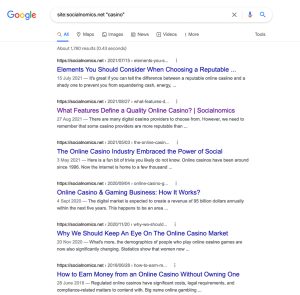
Let’s put this into practice, using the blog Socialnomics as an example. Socialnomics has:
70,000 monthly page views (Simlarweb) = pass.
DR 73 (Ahrefs) = pass.
5,700 OT (Ahrefs) = pass.
1% SS = pass.
Toxic links = fail.
If you click on the second article, you’ll notice the site has paid links. This is something you will undoubtedly want to avoid.
The amount of casino and loan links on Socialnomics makes it highly likely that the website sells links. In Google’s eyes, this is a big no-no. You don’t want to be getting links from websites like this.
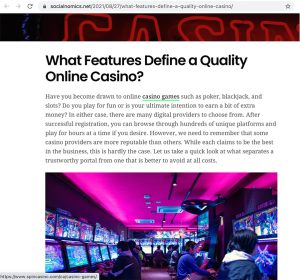
Evidence of the high likelihood of paid links is shown in the image below:
The first red flag is the above article having a dodgy spin casino link that links to a service page, aka a commercial page. The other red flag is the use of direct anchor text matching.
It’s important to note here that if you find a website with links to either casinos or escort services, it means that:
The site is selling links.
The site is a private blog network (PBN).
Link builders should avoid sites like this at all costs. Not only are these kinds of sites low quality, but they could also do more harm than good to a website.
Step 6: Topical relevance and contextuality
You’ll likely use guest posts or link inserts when sourcing new sites for link acquisition. More on both of these link building strategies and tactics will be covered in detail later in this link building guide, but for now, let’s talk about topical relevance.
No matter which link building strategy you use, you must ensure that the link is contextually relevant to the website or page you’re trying to get a link from. The link must be related, relevant, and contextually make sense.
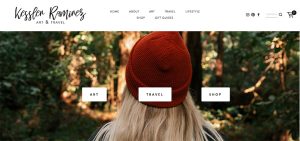
Let’s use the website Kessler Ramirez as a random example. When you look at the site’s nav bar and hero section, you’ll immediately notice that it’s about art, travel, and lifestyle.
The site should be in related verticals if you’re planning a guest post. These could cover topics around:
Travel.
Art.
Camping.
Lifestyle.
Fashion.
Beauty.
Photography.
So it probably wouldn’t make sense to try and get a guest post about social media marketing posted on this site. Topical relevance and contextuality require common sense.
On a semantic level, that means the words surrounding a link should be relevant. The content should also be relevant to a website’s target audience.
Step 7: A nofollow and dofollow link check
Before pitching a site, we’ll check a few pages to see if the outbound links are nofollow or dofollow. But first, what are nofollow and dofollow links?
Nofollow links
Do not pass link juice. From an SEO perspective, nofollow links do not hold any value. That said, there are rumours in the SEO community that Google does count some nofollow links as dofollow. But there is no proof to back this up.
Even if Google does count some nofollow links as dofollow, nobody knows with certainty which sites these could be. We can only speculate.
Some people in the SEO community believe that some editorial nofollow links have SEO value. I’m in that camp, and it’s a hot topic that’s up for debate with SEOs.
Dofollow links
Pass link juice and assist with improving a website’s organic search engine rankings.
How to check if a link is nofollow or dofollow?
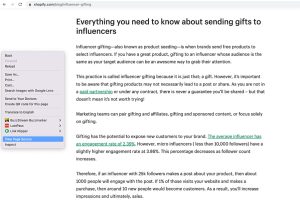
On a Mac, navigate to the page you want to check, right-click, and select “View Page Source”. Like this:
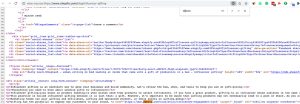
You can then use the Command + F shortcut to open up the find function and find the link more easily. In this example, I’ll do command + F, then add “Oberlo” into the find function to check if the Oberlo link is dofollow or nofollow.
The page’s source code will show you if a link is dofollow or nofollow. In the case of the Shopify link to Oberlo, the link is nofollow. If a page’s source code doesn’t say a link is nofollow, then it’s a dofollow link.
If you’re using SEO software, tools like Moz, Semrush, and Ahrefs will also show you if a link is nofollow or dofollow.
99% of the time, we build links they’re dofollow, but we allow exceptions for links that fall into the digital PR and editorial link bracket. This is because many prominent publications default all outbound links to nofollow.
Bonus: An advanced backlink quality-checking process
In conjunction with our backlink quality check process, one of our link builders runs several advanced checks. Here’s what he has to add:
“I check DR (Ahrefs) and DA (Moz). Then I run a check on a site to get a general feel of what the onsite content feels like on the surface”. He also:
Checks the number and type of pages indexed.
Checks the number of outbound links to domains.
Sorts backlinks and domain list profiles to check what, how, and where metrics for things like the number of repetitions to get a decent idea of the big picture.
Uses Majestic to check the LRT root metrics for flows between the root and inner pages.
Part 3: Guest posts
Creating guest post content is one of the most common methods companies, and agencies use to build backlinks. That said, the SEO community rarely discusses the different strategies link builders use to create guest post content. We’ll share a few strategies with you below, along with the advantages and disadvantages of each tactic.
What is guest posting?
Guest posting is the process of creating an article for a blog or publication to publish under your name.
A guest post is different to a contributor article. When you write a guest post, you’re pitching a one-off article to a blog or website. A contributor post, on the other hand, is written by a writer who regularly publishes content on that particular website or blog.
7 creative guest post strategies
1: Pitch topic ideas
Brainstorm as many topic ideas as possible, turn them into article titles, and pitch them to blogs. If a blog is interested in the content you’re suggesting, they’ll reply with a ‘yes’. You can create the content and include your link in the article.
Advantages
Disadvantages
Minimises the amount of guest post content you need to create. Keeps your content costs down.
Takes a longer time to get links. Requires you to come up with topic ideas frequently.
2: Pitch keyword research
First, locate a target site you want to get a link from. Then, do keyword research to find a relevant topic idea with a keyword that the site hasn’t covered yet (often a longtail keyword). Pitch the keyword research and your content idea to the target blog. If the blog accepts your idea, get the content created.
You can also pitch optimised content using this strategy. By that, I mean use SEO copywriting to optimise your content to get your guest post to rank on page one of Google Search to pass on more link juice and authority to your link. You could also consider building a couple of links to your guest post.
This tactic works especially well for targeting long-tail queries on large sites with a high DR. It also works well for niche sites with topical authority in a given niche with high search volume and a low keyword difficulty (KD) score.
Advantages
Disadvantages
If the blog accepts your keyword research and topic idea, then you’ll have a high chance of your link going live.
You might have to spend more time creating the content. It’s also hard to scale this process as this strategy is usually done on a case-by-case basis.
3: Pitch pre-made content
Create batches of guest posts monthly and pitch these pre-made articles to blogs.
Advantages
Disadvantages
Having the content in advance allows link builders to pitch and get links at scale.
Unless the content you create has an in-depth, unique content angle, it could be hard to get it live. This will make it harder to go live on quality sites.
4: Pitch other people’s content
If you’re friends with other link builders (i.e., they may work at an SEO agency or do in-house SEO for a company), you can ask people if they have any spare content they’re looking to get live.
Advantages
Disadvantages
It doesn’t take much time to ask people for content (email, Google Hangouts, Telegram, Skype, etc.).
You can also save money on content creation and quickly get a free piece of content.
People may not have spare content, and you might need to create the content yourself.
5: Op-eds
An op-ed, also known as an opinion piece, can be a form of digital PR if published in a high-end publication. An op-ed essentially refers to someone sharing their expert opinion or personal experiences on a specific topic.
Advantages
Disadvantages
If you have a unique angle or a strong opinion on a particular topic with a unique perspective, you might gain authorship on a major blog or news publication.
Writing the content and coming up with creative angles can be time-consuming.
6: Private influencer networks
A private influencer network (PIN) is a term that I first read on a blog by Glenn Allsopp from ViperChill (he no longer blogs there). Glenn defines a private influencer network as:
“A group of people looking to rank their websites in Google in similar industries (but not the same) who work together to help each other reach their objectives.”
PINs work in different ways:
Social media: Influencers upvoting or sharing each other’s content. Some PIN groups require influencers to have at least 500K followers to access the private network.
Digital PR: Contributors to high-end publications doing trade and swaps with other influencers. Some PR agencies also make trades with influencers and contributors by doing them a favour (e.g. help get them mentioned in a news article).
Guest posts: Link builders from a similar niche collaborate with similar brands and share guest posts and link opportunities.
PINs exist on social networking sites like private Facebook groups, group chats on Facebook Messenger, Telegram, Google Hangouts, Slack, and WeChat — pretty much any type of communication platform that allows people to communicate quickly.
Advantages
Disadvantages
Link builders can land links on big sites.
It can take quite a lot of time to break into private groups or circles.
7: Egobaiting
Egobait content is the process of getting people to share their opinion or advice on a specific topic, usually in the form of listicle-style content. The idea is that people mentioned in the article will share the content on social media.
From a link building perspective, egobait content is especially linkable. That’s because the content often shares many unique insights on a topic.
The egobait strategy has been around for years and is increasingly becoming a strategy that many SaaS companies, in particular, use to generate 10+ link paybacks.
What’s a link payback?
A link payback is when one link builder owes a link to another link builder. It doesn’t always imply a specific website, but it may sometimes. It is basically like owing a favour.
A real example of an egobait roundup using Google Forms
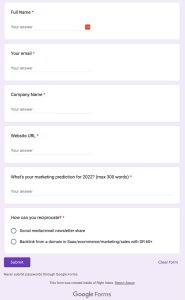
Below is an example of an egobait roundup survey for a guest post that a link builder we know who recently created for a large SaaS company. The person used Google Forms to collect the content. In the example below, we’ve omitted the top section of the form, which has the article topic, site metrics, and deadline for answering the request.
This article had 30+ responses to the request and generated at least 30 link paybacks. That’s a tonne of links using this strategy.
Advantages
Disadvantages
This strategy has the potential to yield a lot of link paybacks (i.e. 10-30 links in one hit).
The strategy can be hard to pull off if you don’t have the right connections. You’ll also need a large site to yield a lot of responses.
If a site decides to strip your links, a lot of time will be wasted as people will be less inclined to pay back the link.
How to find sites for guest posting?
One of the most common ways to find a website for guest posting is to use a Google Search operator. A Google Search operator is an advanced search query that you can use to find something specifically based on your set parameters.
1. Use ‘write for us’ searches
Let’s say you’ve written an article about a specific topic. You could use the ‘write for us’ Google Search operator in Google Search by searching for this query along with the topic. For example:
A tech topic: “Tech” + “write for us”
A food topic: “Food” + “write for us”
A social media topic: “Social media” + “write for us”
Be aware that a lot of the sites you might find using the ‘write for us’ Google Search operators are likely to be either:
Low-quality: Sites that are spammy and selling links. If a site tries to charge you to publish an article, run away as fast as possible and avoid any website like this at all costs.
High-quality: For example, a major news site that may be way out of your league.
You will, of course, find legitimate blogs and publications as well. But, as a rough guess, I’d estimate those to be around 5% to 10% of the results you find. Or even less, depending on the niche. Hence, the vast majority of ‘write for us’ searches are mostly useless.
2. Backlink gap analysis
You can run a backlink gap analysis on SEO tools like Semrush to determine which sites your competitors have links from that your website does not. The process is quite simple. All you need to do is export the data, and you’ll have a target list.
You’ll need to filter the data by different metrics. For example, ‘AS’ stands for authority score. Semrush rates specific domains on a scale of 1 to 100. It is similar to the Ahrefs domain rating (DR) score and Moz’s domain authority (DA).
Just enter your client’s website as the first root domain, then your competitors in the following root domains. Click “find prospects”, and Semrush will display a list of sites your competitors have backlinks from that your website does not.
Our thoughts: Don’t place too much emphasis on a backlink gap analysis. The quality of a link varies greatly. Some SEO agencies will focus on gaining competitor links, but this may not always be the best approach.
Our unique insight: A lot of SEO agencies struggle with off-page SEO. This means that there’s a high probability that many of your competitor’s backlinks are likely to be paid links. As a link builder, it will be your responsibility to determine which link targets are quality vs. low-quality.
3. Guest post collaboration
Guest post collaboration is another way to find new sites to write for while at the same time getting more links. There are a few different ways this could work:
Sharing a spreadsheet between different link builders.
Joining different groups and collaborating with other link builders and brands.
Collaborating with other link builders through email.
If you collaborate with other link builders, you’ll learn which website they have access to. This means you could potentially pitch to these sites too.
4. Startup directories and social sites
Startup directories and social sites like BetaList and Product Hunt can provide many opportunities for pitching guest posts to build links.
This is because many startups are open to receiving guest post pitches. The cool thing is that some of the startups on both of these websites could grow quite big.
An example of BetaList
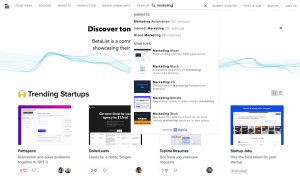
If you navigate to BetaList’s homepage, you’ll notice a search bar in the Nav bar section. In the example below, I’ve typed in marketing for illustration purposes.
You’ll notice that there are three marketing subcategories:
Marketing automation (142 startups).
Internet marketing (251 startups).
Brand marketing (140 startups).
There’s already a hit list of 500 potential targets in that one search alone.
An example of Product Hunt
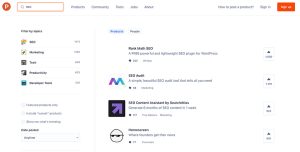
This works in the same manner as BetaList. Just head on over to the search bar.
There are a few benefits to using Product Hunt:
You can filter by topics and subtopics.
There are thousands of products on there.
You can also use it for influencer marketing and creating egobait content as it displays “people”.
You can use it for domain acquisition, i.e. plenty of companies listed on Product Hunt will have editorial links. Some of the sites may have closed down. So you can check a site’s backlink profile to see if the domain name is available.
On the downside
BetaList and Product Hunt will have a bunch of startups listed on their site that have closed down. So you’ll need to sort through data to determine which startups are active and inactive.
Part 4: Reducing the likelihood of a link being stripped
As per Google guidelines, “Any links intended to manipulate PageRank or a site’s ranking in Google search results may be considered part of a link scheme and a violation of Google’s Webmaster Guidelines. This includes any behaviour that manipulates links to your site or outgoing links from your site.”
What does this mean, and why is it important? Well, links should be natural. You should not pay for links or try to manipulate Google’s PageRank.
If Google suspects that a website is engaging in practices like direct anchor text matching (the link text in an article using a keyword that links to a page with that exact keyword), then Google may penalise you for that.
How to create natural backlinks?
The easiest way to create natural backlinks is by following a few simple rules to improve the chances of your link going live.
Rule 1: Link to connecting words
If you want to decrease the chances of your link being stripped (i.e. your article is published, but an editor has removed your link), then an excellent idea is to link to connecting words.
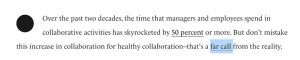
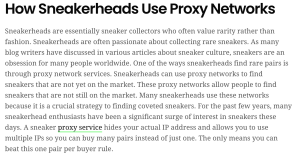
Here’s a random example:
The link “far call” is an internal link. If this was an outbound link, then this could be a great place to link to a connecting phrase to add information that supports that specific section.
Here’s an example of what not to do:
With this example, you’ll notice that there is a promotional “proxy service” link. From a glance, it is obvious to both editors and readers that the article was created purely for SEO and link building purposes. The proxy service link has done two things wrong, these being:
Using keyword-heavy anchor text.
Linking directly to a service page (money, transactional, sales page).
The link not providing any value.
If the link did want to provide value, it should be linking to something that explains exactly what a proxy service is, why it is essential, and what the benefits are. But, because it doesn’t and links to a service page, this is a black hat link trying to game Google’s Pagerank.
Rule 2: Link to linkable assets
Ahrefs defines a linkable asset as, “A piece of content purposely crafted with the intention of attracting links — usually from other websites in your niche”.
Ahrefs also provides five classifications for linkable assets, these being:
Infographics, GIFographics, and Map-o-graphics.
Online tools and calculators.
Awards and rankings.
Studies and research.
Definitive guides and tutorials.
Your goal from a link building perspective should be to try and link to things that provide value to a reader because that’s essentially what a backlink is — a citation.
Linkable assets can also be used for digital PR, especially if the content is fresh and contains unique data or research.
Rule 3: Link to sources
Remember back when you were a student at university, and you had to write essays? When you referenced something in an essay, it was considered a source.
In the same way, news sites and blogs also link to sources. The way to take advantage of this is to make your clients become sources. And this could be done in a few ways, such as:
Linkable assets: Conducting in-depth research, studies, reports, etc.
Expertise: If a client is an expert in a specific area, then you can also draw on that knowledge in a wide range of ways like referencing something they said in a blog article, podcast, or on YouTube, answering quotes (e.g. HARO, Source Bottle, Qwoted, etc.), or by getting a client authored on publications (i.e. an op-ed, opinion piece).
Rule 4: Link placement page location
Almost every news site or blog prefers to have internal links in the article’s introduction, body, and conclusion. Here are two-page locations to avoid:
1. Introduction section
Links in the introduction of an article are the most valuable and pass on more link juice. For that reason, most sites will strip outbound links in the intro and replace them with an internal link to their site.
Not every site will do this, however. If a story is referencing something specific in the introduction, like a statistic, your link is more likely to stay there.
2. Conclusion section
When a person reaches the conclusion of a news or blog article they’re reading, they’ll tend to either:
Click on a related article.
Click on a link in the conclusion.
Go back to the home page.
Exit the site.
Most publications prefer to have their internal links in the conclusion area. That makes them more likely to strip your link and replace it with their own to stop people from leaving their website.
Link placement is crucial. Ideally, the best links come from the introduction area of an article or post. But if you don’t have a linkable asset to link to (e.g. a statistic), then it is better to target the body sectionof an article to increase the chances of your link being published.
Rule 5: Add internal links
If you add internal links to the site you’re pitching to, you’ll be helping the editor out by giving them one less thing to do.
Adding internal links shows the editor that you’ve taken the time to check out the content on their site. It also increases the chances of your link going through. This is because when you add internal links:
Your link will appear more natural.
If the editor is doing a quick content check and notices many keyword-based links are internal, then they might not even check yours.
Part 5: Pitching GPs to large authoritative sites
It will be pretty tough to pitch to a major publication if a link builder has no experience writing, creating guest posts, or authoring content online.
Outside of the link building sphere, there are some caveats to this:
Some college students studying journalism and communications might be fortunate enough to land a job as a journalist or intern writing for a large news site.
People already influential, wealthy, or an employee from a company (or previous company) that exhibits a sphere of influence (e.g. an ex-Googler that has never written an article before).
Understanding what editors want
Most blogs have a style guide, writing style, and content focus. Take the time to review a website’s content before pitching an article or story to an editor. I like to think of it like this:
A link builder’s job is to make an editor’s life easier, not harder. That means if you can do as many things as possible to make an editor’s life easier, they’ll be more likely to accept your content.
This makes the possibility of the content being accepted much higher. If an editor likes the article, then all they have to do is publish it.
Here are some key things to take note of when you’re trying to make an editor’s life easier:
Title styles: E.g. APA style, MLA, or Chicago.
Title length: If the title is too long, a part of it will be cut off from search engines. Ideally, you will want the title to be less than 580px. You can use a free tool like Higher Visibility’s SERP Snippet Optimiser to check that your title doesn’t exceed the recommended character limit.
Subheading styles: E.g. APA style, MLA, or Chicago.
Dash styles: E.g. En dash vs em dash.
Quote attribution styles: Attributing the exact quote to a specific communication form, e.g., Name, told me in an email that “insert a quote”.
Language: E.g. American English or British English.
Grammar: We recommend checking your grammar using Grammarly Premium. Pay specific attention to things like passive voice vs active voice, clarity, and writer tone.
The story angle: A flat story vs a story that shares real insight.
Some problems I faced initially in the early days
When I first started trying to write for small to medium-sized blogs, the number one thing I struggled with was content, not the email pitch. I think being able to create compelling copy comes down to various things, such as:
Writing quality: The way your content reads from start to finish.
Story angle: Creating an interesting angle on something fresh, new, and engaging.
Writing styles: The ability to use different writing styles. For example, storytelling vs news-style content that uses a ‘nut graf.’
Time: The longer you write, the more experience you have. So, in theory, your content should be better after writing for a year vs when you’ve only been writing for a month.
Content speed: I find that writing content based purely on personal experience might only take me around 4-5 hours to write. On the other hand, if the content is technical or requires a lot of research, it can take me 1-2 days to write, or perhaps even longer if it’s editorial-based.
How to get started with story ideation?
The easiest way to get started is to write a somewhat personal story. This is because if you speak from first-hand experience, then you already know the story. You just need to tell it.
This could be an X by Y personal story, like:
How I lost 30 pounds by changing my diet.
How I grew my business from $0 to $500,000 by creating quirky emails.
I failed my job interview by ‘accidentally’ making this mistake.
Another easy way to start writing would be to create a listicle. Here are some random examples that I’ve made for illustrative purposes:
7 SaaS companies from Australia that are crushing it.
5 things you are probably doing wrong on social media.
4 easy food ideas that you can make in under 30 minutes.
Once you’ve finished writing your article, the next step is to pitch your story to a small or medium-sized blog. If you think your story has legs, then you could try a larger publication.
Think virality without the intention of going viral
Derek Halpern, founder of Social Triggers wrote an article in 2014 about why things go viral. I think the main points behind the article still hold relevance today. People talk about and share online things:
They remember.
That matter.
That deliver practical value.
That project who they want to be to their friends.
That are controversial.
That other people talk about (and share).
That entertains them.
Think about the emotions you want to evoke
The PR firm Martin Communications published an excellent graphic showing the correlation between human emotions and content creation.
The above graphic shows that your article is more likely to go viral if you arouse emotions from readers. When people write and create content, they typically do so with an idea in mind. Rarely do writers factor in emotions, which can be used to your advantage.
Your LinkedIn profile matters, and for different reasons
In my case, I’m the founder of Earned Media, an SEO-only agency specialising in both technical SEO and off-page SEO. If I’m pitching content to large publications about digital marketing or SEO, it makes sense to share my expertise on these topics.
My LinkedIn profile is backed by social proof:
There’s a picture of me on an SEO panel with a Googler.
If you click on my LinkedIn avatar, people can view a short reel of me talking on TV with David Koch. The videos are also visible on my LinkedIn profile’s “featured” section.
The experience section of my LinkedIn profile shows that I’m the founder of Earned Media and a contributor to Entrepreneur and Flying Solo.
LinkedIn profile considerations
If you’re purely writing about SEO, it’s OK to write about SEO or marketing in prominent publications. Your personal brand should reflect this and not go off-tangent (i.e. writing about personal finance, camping, travel, insurance, etc.).
But if you’re trying to write for large sites purely for link building purposes, that’s an entirely different ball game. That’s because you’re probably trying to do a couple of things, like:
Disguise links. If an editor knows you’re creating content purely for link building, then they are highly unlikely to publish your content.
Write on various beats. If you’re pigeonholed into one beat, it limits how many links you can build. But if you can write on several topics, you can get more links.
To get around this, you might be better off becoming a “ghost.” By that, I mean that if you’re 100% doing SEO, then you probably wouldn’t want to have “SEO agency” or “link building” associated with your LinkedIn profile unless you’re solely building links in the SEO space.
Why not? Because if an editor searches for you on LinkedIn and discovers that you’re just another marketer or link builder, then they’ll probably just ignore your pitch.
Thinking outside the box
One good example of this comes to mind. Let’s say you want to write for a big site like Inc., Fast Company, or VentureBeat. Think about what an editor on that site might think, feel, or do.
A link building story
A guy I know realised that many PR people, SEOs, and consultants pitch significant publications, either trying to promote themselves or a client.
This is what he worked out:
PR people: Try to disguise that they’re promoting a client.
SEOs: Try to disguise their links in the content.
Consultants: Try to promote themselves.
He reversed engineered this by asking himself, “What can I do differently from the 99% of people I’m competing with?”
He realised he needed to do something entirely different to how PRs, SEOs and consultants try to get their content on large sites. So, what did he do?
He cold-emailed a billionaire. He asked the billionaire if he could interview him on a topic that he knew the billionaire would be interested in.
The billionaire agreed. He then pitched that story exclusively to a huge publication, which accepted the content and made him a contributor.
The point here is this: thinking outside the box and doing things differently can help you stand out from the crowd. Sometimes it can pay off to be creative.
Part 6: Niche edits
If you’re managing a large link building team, link inserts can be a lot like sales leads, with outreach responses being the “leads”. Niche edits are one of the most powerful ways to build high-impactful links.
What is a niche edit?
A niche edit is a link building term that describes the process of emailing a website and asking them to update a pre-existing article and add a new backlink to a specific page. Niche edits are also called link inserts or link insertions.
There are two types of niche edits:
Black hat niche edits: Paying a site directly for a link to be added to a specific page.
White hat niche edits: Pitching a site directly for a link to be added to a specific page.
I’m only going to focus on white hat niche edits, as we don’t do any black hat niche edits (and I’d strongly recommend that you don’t as well).
What you’re led to believe in how niche edits work
If you read many SEO blogs, they’ll say something generic like this.
Step 1: Email a site with a bit of praise about their article.
Step 2: Mention that you’ve written an article about a topic related to an article on their blog, and say it would make your day or entire year if they could add your link to their blog. Tell them their audience will find it valuable.
This particular strategy usually doesn’t work well unless you provide extreme value. For example:
If you’re running a broken link building campaign and you’re solving a broken link problem for a specific site. In this case, an outreach campaign will work.
If you’re a well-known brand that has created an epic piece of content with new data, this will also work.
How do most niche edits work?
This is one of those SEO secrets that people don’t want to discuss publicly. From what I’ve seen, most SEOs in the link building space know this. But interestingly enough, I’ve never read about this online.
Most niche edits work on a trade-based system
Niche edits work on a trade-based system, whereby link builders will make a 3-way or 4-way link trade. This is how it works:
Site A: The site you want to get a link from gets a link from Site C.
Site B: The site you want to get a link from gets a link from Site A.
Site C: The link builder will get Site A a link from a site they are offering (often a guest post on a different site).
What kinds of companies could I expect?
Companies ranging from tiny blogs to large enterprise fortune 500 companies are doing niche edit 3-way swaps.
The key to this tactic is the offer
Imagine this scenario. You want to get a link insert from a massive well-known site. The person who runs SEO for that particular company will know their brand power.
A link builder’s offer needs to be equal to, or even better than, the site a link builder is trying to get a link from.
This may sound easy for small to mid-sized sites, but when playing on the enterprise level, this can get quite hard. But not impossible. It might just take a bit of time to facilitate the trade.
Here is a real example of a 3-way high-end trade from one of our link builders:
The link we got: We got a client a link from a well-known DR 90+ site with over one million organic traffic. The company is publicly listed on NASDAQ. This particular link was massive because we used the ETV method (which we’ll share more on below).
In return: We got this company a dofollow link on VentureBeat (a major U.S. news site) via a guest post. VentureBeat has a 91 DR and receives approximately 1.9 million in organic traffic. This is something that is not easy to achieve.
 Ahrefs shows that Redfin has a DR of 89, which is relatively high. The DR can vary quite a bit in different industries and regions.
We use the following metrics as a benchmark to maintain consistent quality:
Ahrefs shows that Redfin has a DR of 89, which is relatively high. The DR can vary quite a bit in different industries and regions.
We use the following metrics as a benchmark to maintain consistent quality:
 Click on the orange search button to view the organic traffic (OT). Ahrefs will display the site’s organic traffic, as seen in the example below.
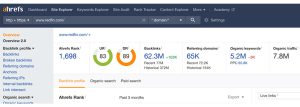 In this example, Redfin gets approximately 7,800,000 in OT, indicating that it could be a valuable link target.
It’s important to note that the OT data from Ahrefs can be inaccurate from time to time. This could be due to a variety of factors, such as:
In this example, Redfin gets approximately 7,800,000 in OT, indicating that it could be a valuable link target.
It’s important to note that the OT data from Ahrefs can be inaccurate from time to time. This could be due to a variety of factors, such as:
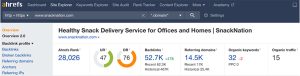 It’s tough to spot when Ahrefs OT data is inaccurate.
If you use a combination of other tools, like Similarweb and BuiltWith, you’ll be able to identify when something like this occurs.
Similarweb shows that SnackNation gets approximately 681,000 monthly page views, a significant discrepancy from the 15 in OT that Ahrefs is showing.
It’s tough to spot when Ahrefs OT data is inaccurate.
If you use a combination of other tools, like Similarweb and BuiltWith, you’ll be able to identify when something like this occurs.
Similarweb shows that SnackNation gets approximately 681,000 monthly page views, a significant discrepancy from the 15 in OT that Ahrefs is showing.
 You can dig deeper using BuiltWith by clicking on “detailed technology profile”. You’ll notice that SnackNation is using an “Ahrefs bot disallow,” which prevents Ahrefs from accessing all its website data. This proves that the Ahrefs OT data for SnackNation is inaccurate.
 The screenshot we used above of Ahrefs OT discrepancy of SnackNation was taken a few months ago. We rechecked Ahrefs recently, and it now displays the correct OT
 This is why you cannot rely on just one indicator sometimes. Instead, use several metrics as a backup whenever your gut tells you there is a data discrepancy.
 There are, however, logical exceptions to this.
For example, the Australian Financial Review (AFR) is a prestigious financial news publication with a spam score of 11%. You can see this in the image below.
There are, however, logical exceptions to this.
For example, the Australian Financial Review (AFR) is a prestigious financial news publication with a spam score of 11%. You can see this in the image below.
 Most brands would be over the moon to get a link or brand mention on the AFR.
In this case, getting a link from the AFR is fine as it’s a major reputable news site that gets a tonne of traffic.
Most brands would be over the moon to get a link or brand mention on the AFR.
In this case, getting a link from the AFR is fine as it’s a major reputable news site that gets a tonne of traffic.
 SimilarWeb also shows other useful information, such as:
 If you click on the second article, you’ll notice the site has paid links. This is something you will undoubtedly want to avoid.
The amount of casino and loan links on Socialnomics makes it highly likely that the website sells links. In Google’s eyes, this is a big no-no. You don’t want to be getting links from websites like this.
Evidence of the high likelihood of paid links is shown in the image below:
If you click on the second article, you’ll notice the site has paid links. This is something you will undoubtedly want to avoid.
The amount of casino and loan links on Socialnomics makes it highly likely that the website sells links. In Google’s eyes, this is a big no-no. You don’t want to be getting links from websites like this.
Evidence of the high likelihood of paid links is shown in the image below:
 The first red flag is the above article having a dodgy spin casino link that links to a service page, aka a commercial page. The other red flag is the use of direct anchor text matching.
It’s important to note here that if you find a website with links to either casinos or escort services, it means that:
The first red flag is the above article having a dodgy spin casino link that links to a service page, aka a commercial page. The other red flag is the use of direct anchor text matching.
It’s important to note here that if you find a website with links to either casinos or escort services, it means that:
 The site should be in related verticals if you’re planning a guest post. These could cover topics around:
 You can then use the Command + F shortcut to open up the find function and find the link more easily. In this example, I’ll do command + F, then add “Oberlo” into the find function to check if the Oberlo link is dofollow or nofollow.
 The page’s source code will show you if a link is dofollow or nofollow. In the case of the Shopify link to Oberlo, the link is nofollow. If a page’s source code doesn’t say a link is nofollow, then it’s a dofollow link.
If you’re using SEO software, tools like Moz, Semrush, and Ahrefs will also show you if a link is nofollow or dofollow.
99% of the time, we build links they’re dofollow, but we allow exceptions for links that fall into the digital PR and editorial link bracket. This is because many prominent publications default all outbound links to nofollow.
The page’s source code will show you if a link is dofollow or nofollow. In the case of the Shopify link to Oberlo, the link is nofollow. If a page’s source code doesn’t say a link is nofollow, then it’s a dofollow link.
If you’re using SEO software, tools like Moz, Semrush, and Ahrefs will also show you if a link is nofollow or dofollow.
99% of the time, we build links they’re dofollow, but we allow exceptions for links that fall into the digital PR and editorial link bracket. This is because many prominent publications default all outbound links to nofollow.
 This article had 30+ responses to the request and generated at least 30 link paybacks. That’s a tonne of links using this strategy.
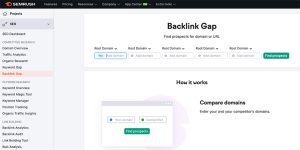 Just enter your client’s website as the first root domain, then your competitors in the following root domains. Click “find prospects”, and Semrush will display a list of sites your competitors have backlinks from that your website does not.
Our thoughts: Don’t place too much emphasis on a backlink gap analysis. The quality of a link varies greatly. Some SEO agencies will focus on gaining competitor links, but this may not always be the best approach.
Our unique insight: A lot of SEO agencies struggle with off-page SEO. This means that there’s a high probability that many of your competitor’s backlinks are likely to be paid links. As a link builder, it will be your responsibility to determine which link targets are quality vs. low-quality.
Just enter your client’s website as the first root domain, then your competitors in the following root domains. Click “find prospects”, and Semrush will display a list of sites your competitors have backlinks from that your website does not.
Our thoughts: Don’t place too much emphasis on a backlink gap analysis. The quality of a link varies greatly. Some SEO agencies will focus on gaining competitor links, but this may not always be the best approach.
Our unique insight: A lot of SEO agencies struggle with off-page SEO. This means that there’s a high probability that many of your competitor’s backlinks are likely to be paid links. As a link builder, it will be your responsibility to determine which link targets are quality vs. low-quality.
 There are a few benefits to using Product Hunt:
 The link “far call” is an internal link. If this was an outbound link, then this could be a great place to link to a connecting phrase to add information that supports that specific section.
Here’s an example of what not to do:
The link “far call” is an internal link. If this was an outbound link, then this could be a great place to link to a connecting phrase to add information that supports that specific section.
Here’s an example of what not to do:
 With this example, you’ll notice that there is a promotional “proxy service” link. From a glance, it is obvious to both editors and readers that the article was created purely for SEO and link building purposes. The proxy service link has done two things wrong, these being:
 The above graphic shows that your article is more likely to go viral if you arouse emotions from readers. When people write and create content, they typically do so with an idea in mind. Rarely do writers factor in emotions, which can be used to your advantage.