
The primary purpose of a website design is to offer the best user experience.
Responsive web design is the first step to making that happen because it renders the same code for all devices irrespective of the screen size.
If you have spent thousands of dollars creating a fancy site for your business that fails to attract organic visitors, then that’s a waste of your time and money.
An optimised SEO site design can result in more clicks. Moreover, 57% of businesses don’t recommend a business whose website doesn’t load properly on mobile devices.
Optimised design perfects your SEO resulting in enhanced organic visibility, more clicks, and higher sales.
It is easy to avoid design disasters by following some simple guidelines.
Here are the top five site design mistakes that ruin SEO:
1. Missing breadcrumb trails
Lacking nicely structured and engineered breadcrumb trails can weaken the SEO performance of your website. Breadcrumbs are the text paths that are usually located at the top of a page. It helps users know their location on the site. For example, a breadcrumb for an online shopping store should look like this – category -> subcategory -> product: As you can see from the example above, a breadcrumb offers easy navigation. Visitors can quickly locate their path. Moreover, with just one click, they can go back to the previous page.
Breadcrumbs are essential for SEO because:
As you can see from the example above, a breadcrumb offers easy navigation. Visitors can quickly locate their path. Moreover, with just one click, they can go back to the previous page.
Breadcrumbs are essential for SEO because:
- Google Loves Them: Breadcrumbs help Google identify the structure of your website. Also, Google may display them in search results. Such results are more informative to users, and they are more likely to click on them to explore other pages of your site.
- Minimises Bounce Rate: With breadcrumbs, visitors can move to the other pages of the site if the selected page didn’t meet their requirements. By providing an easy alternative to move to other pages, you minimise the chances of bounce rate.
2. Non-mobile friendly and slow loading speed
Google switched to mobile-first indexing in September 2020, and as of Q1 in 2023, around 58.33% of internet users were mobile internet users. This means if your site design doesn’t support mobile devices, then it is not visible to your potential customers. Upgrading your site to use a responsive design and be mobile-first offers a better user experience. At the same time, you must also check the loading speed of your site. A slow-loading site can negatively impact ranking, traffic, and sales. This is because when it comes to page loading, customers aren’t patient enough and prefer leaving. So, site speed is directly related to a higher bounce rate. No matter how well you have designed your website, non-mobile-friendly site design and slow loading time can damage all your SEO efforts.3. Poor URL structure
URLs that are not user-friendly are a significant reason for decreased rankings. Your URL must be able to tell search engines and users about the contents of your page. Using an irrelevant page URL like 123.html or product2.html is not a good practice. Search engines use URLs to determine the relevancy of a particular page or resource with a search query. Therefore, your URL structure must follow an SEO-friendly format. Here is an example of an SEO-friendly URL structure:- Protocol – HTTPS
- Subdomain – store
- Domain – example
- Top-level Domain – com
- Folder – topic
- Page – descriptive-product-name
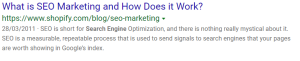 It has a clear URL name, is human-readable, and is semantically accurate. So, it is helping search engines to identify the relevance of the page for specific search queries to offer a better user experience.
4. Missing heading and title tags
Heading and title tags are often mistaken as cosmetic elements by designers, but in reality, they are the most essential ON-page elements of a page. Apart from structuring the content, heading tags improve the relevance score of your content for your target keywords. Similarly, Google’s algorithm is programmed to identify the page’s purpose and relevance with the title. Title tags are the summary of your page that are visible both to the user and the search engine. So, if the title is eye-catching and informative, it will stand out from similar titles across the SERP. As a result, users are more likely to click on the link to navigate to your website resulting in higher click-through rates.5. Using too many images and annoying ads
Attractive images on a webpage lift its looks. However, using too many images is not good for SEO. Using lots of optimised images increases the weight of the page, leading to slow page loading. If your page takes time to load, your rankings will slip, resulting in a loss of traffic. As suggested in the image below, the structure of your site should always present the main content above the fold. Sites that push content below the fold do not offer a good user experience.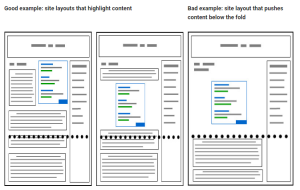 Source
Don’t annoy your audiences with unwanted popup ads or banner ads because if you do so, you increase the chances of not adhering to Google’s requirements. Ultimately, your SEO suffers.
SEO involves careful, thorough, and detailed consideration of every aspect of page designing. A minor ignorance can ruin your months of effort.
As the digital world is evolving, it is highly essential to take care of every minute factor to have a successful web presence. By working on the above-listed site design mistakes, you can surely improve your SEO and get the desired results.
Source
Don’t annoy your audiences with unwanted popup ads or banner ads because if you do so, you increase the chances of not adhering to Google’s requirements. Ultimately, your SEO suffers.
SEO involves careful, thorough, and detailed consideration of every aspect of page designing. A minor ignorance can ruin your months of effort.
As the digital world is evolving, it is highly essential to take care of every minute factor to have a successful web presence. By working on the above-listed site design mistakes, you can surely improve your SEO and get the desired results.