
AI search (including GEO) is the process of making your content understandable and citable within AI-generated answers across platforms like ChatGPT, Google AI Overviews, Perplexity, and Copilot.
Earned Media helps brands recapture traffic lost to AI search. We are now seeing 60% of searches ending without a click, while Google AI Overviews reach more than two billion users every month. At the same time, 49% of Australians have used generative AI in the past year, and that number is climbing fast.
The opportunities are there. Are you ready to be seen?
In this guide, I'll show you how to capture attention with GEO, how to run an audit, and how to build a plan that gets your brand surfaced across AI-generated answers.
Key takeaways
- Search queries are becoming longer, more conversational, and more specific.
- AI systems prioritise easy-to-understand, trustworthy, and well-structured content.
- You can perform an AI-search audit yourself or get a free audit from Earned Media.
What do GEO and AEO mean?
GEO (Generative Engine Optimisation) and AEO (Answer Engine Optimisation) sit within the next phase of SEO. These new tactics are shaped by how AI search engines generate responses, rather than returning a list of links.
AEO focuses on making your content the direct answer. This shows up in environments like Google's AI Overviews, where clear, well-structured responses are pulled straight into the result.
GEO takes a broader view. It's about ensuring your content is referenced by AI models like ChatGPT and Gemini when they build an answer from multiple sources.
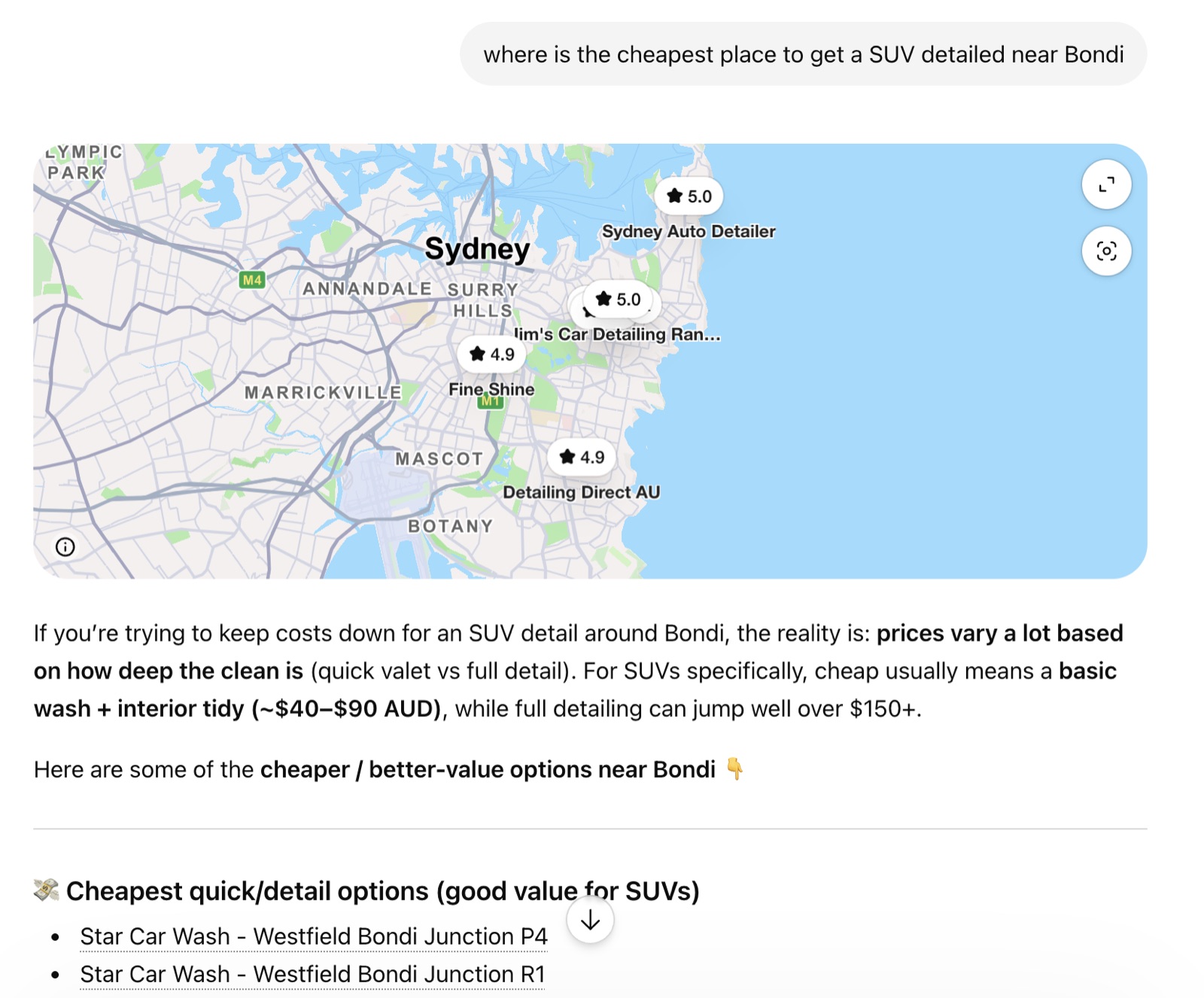
A big part of this shift is driven by changes in how people search. Queries people enter into AI have become longer and are often more specific. So, "best car wash Sydney" has now become "Where is the cheapest place to get an SUV detailed near Bondi?"
SEMrush estimates that by 2028, website traffic from AI searches may surpass traffic from traditional searches. Now is the perfect time for brands to begin to pivot towards optimising for AI search.
To help you understand the new generation of search marketing, here's an overview of the core differences between approaches.
SEO vs. AEO vs. GEO
| Area | SEO | AEO | GEO |
|---|---|---|---|
| Primary goal | Get your page to the top of Google's results | Provide the direct answer to a question | Be referenced within AI-generated answers |
| Content style | Built around keywords | Built around questions | Built around clusters of queries and intent |
| Visibility | Appears as links in search results | Appears in an AI overview | Appears within a generated response |
| Search behaviour | Short, keyword-based searches | Question-based searches | Long, detailed, conversational prompts |
| Keyword strategy | Focuses on one main keyword per page | Focuses on a specific question | Covers many variations of queries |
| User intent | Broad intent — informational or transactional | Clear, question-based intent | Complex intent tied to a task or outcome |
| Success metrics | Rankings, clicks, traffic | Inclusion in AI overviews | Inclusion in LLM answers and increased traffic from LLM sources |
| Conversion path | User clicks, then converts | User sees the answer, then may click | User sees the answer, which builds awareness; they may visit later |
At Earned Media, we are finding the content that gets the most buzz in 2026 is dual-purpose content: it shows up in AI overviews by answering questions succinctly, and it also covers niche topics that match longer, more specific search prompts.
How AI search is changing organic visibility
The bar for organic marketing has been significantly lifted by AI. A big part of that comes down to how visibility is distributed. Where traditional search might show 10 results, AI often surfaces only a handful, or sometimes only one.
This is already playing out for businesses. One Australian marketing consultancy built up thousands of pages of content over the years to attract customers through Google. Almost overnight, that traffic dropped by around 80% as AI-generated answers began replacing traditional search results.
"It's essentially thousands and thousands of hours and years and years of work to generate this content."
— Mr Woolley, former chair of the Australian Marketing InstituteBroader data reflects the same trend, with Ahrefs reporting that average search traffic has dropped by 21% over the past year, while its AI traffic has grown roughly 10 times.
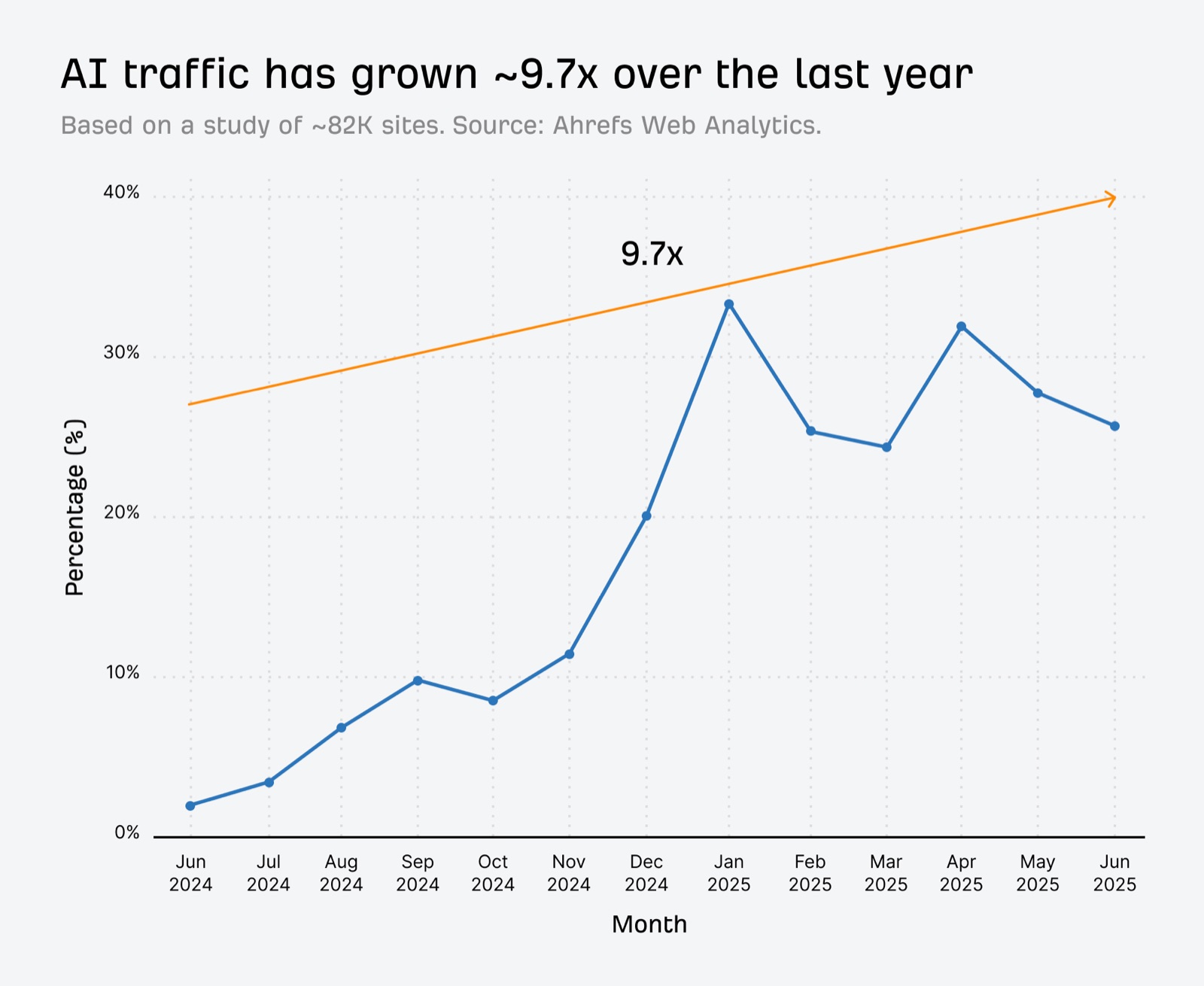
At the same time, AI systems prioritise pages that clearly answer the query, align closely with user intent, and are consistent with other trusted sources across the web. That creates a much tighter window to be seen. Right now, 26% of brands have zero mentions in AI overviews.
While it might feel like your audience has disappeared, they haven't. They're still searching, but they're searching in different places — whether that's AI overviews or LLMs.
Earned Media has seen that brands making even small adjustments to their content strategy are often able to improve how frequently they surface across AI-generated answers.
How AI search engines find, understand, and cite content
As I've covered, AI search engines don't index pages like Google used to. Instead, they break a query down, explore multiple angles, and then build an answer using a small set of sources that they trust. Here's how the process works from start to finish.
Step 1: Understand the full query
When someone enters a prompt, the LLM doesn't treat it as a single search. It expands it into multiple related queries to fully understand what the user is trying to achieve.
For example, a query like "What is the best HR agency for a growing startup?" might expand into:
- Best HR agencies for startups
- Affordable HR agencies for small businesses
- HR agencies that specialise in recruitment and compliance
- HR agency reviews and comparisons
This is often called query fan-out, and it's how AI systems search far and wide before deciding what to include.
Step 2: Scan the web for answers
Once the system understands the different angles, it retrieves content from across the web. This step is similar to traditional search, but covers a wider number of pages. This is the stage where your content either gets picked up or ignored.
Step 3: Make sense of the content
After retrieval, the system needs to interpret the content. Instead of scanning for keywords, AI models identify:
- What the topic is
- Who or what is being discussed
- How different concepts relate to each other
For example, it understands that "HR agency," "recruitment agency," and specific company names might all refer to the same type of service.
What can we learn from this? If your page clearly explains what you do, who you help, and where you operate, it's much easier for AI to use it.
Step 4: Decide what's worth using
From there, the system narrows down the list and prioritises content that is clear, matches the user's intent, lines up with what other sources say, and shows signs of credibility.
Credibility comes from signals like real expertise, brand identity, and supporting evidence.
Step 5: Combine it into a response
Once the sources are selected, the system generates a response by combining them. This is called dynamic answer synthesis. This means that your content might be used without being directly quoted word-for-word.
Step 6: Link back to sources
Depending on the platform, the system may show where the information came from.
- Google often includes linked sources
- ChatGPT sometimes references sources depending on the query
- Perplexity shows citations more explicitly
These citations give your brand additional opportunities for visibility, as well as a place for people to click. If you're seeing "source: chatgpt" or other similar sources in analytics, that's coming from these citations.
How can you use this information?
In short, to be included, your content needs to do these three things:
- Answer the query clearly and early on the page
- Align with how people ask these questions
- Be consistent with other trusted sources
If it does, you have a much higher chance of being selected and referenced by LLMs.
The key elements of a GEO and AI SEO strategy
To target AI search, you need to change your discoverability strategy. Instead of trying to rank a page, you're trying to be included when an AI system builds an answer. That means covering the different ways people ask, structuring content so it can be pulled into responses, and reinforcing your authority across the web.
Here's how we approach it at Earned Media.
AI search intent research
Instead of starting with keywords, start with how people search for what you offer.
Look at Google Search Console to find the longer, more specific queries people are already using to discover your site. These are often closer to how people phrase prompts in AI. You can then expand this by asking AI tools to generate variations, such as questions, comparisons, and scenario-based prompts related to your product or service.
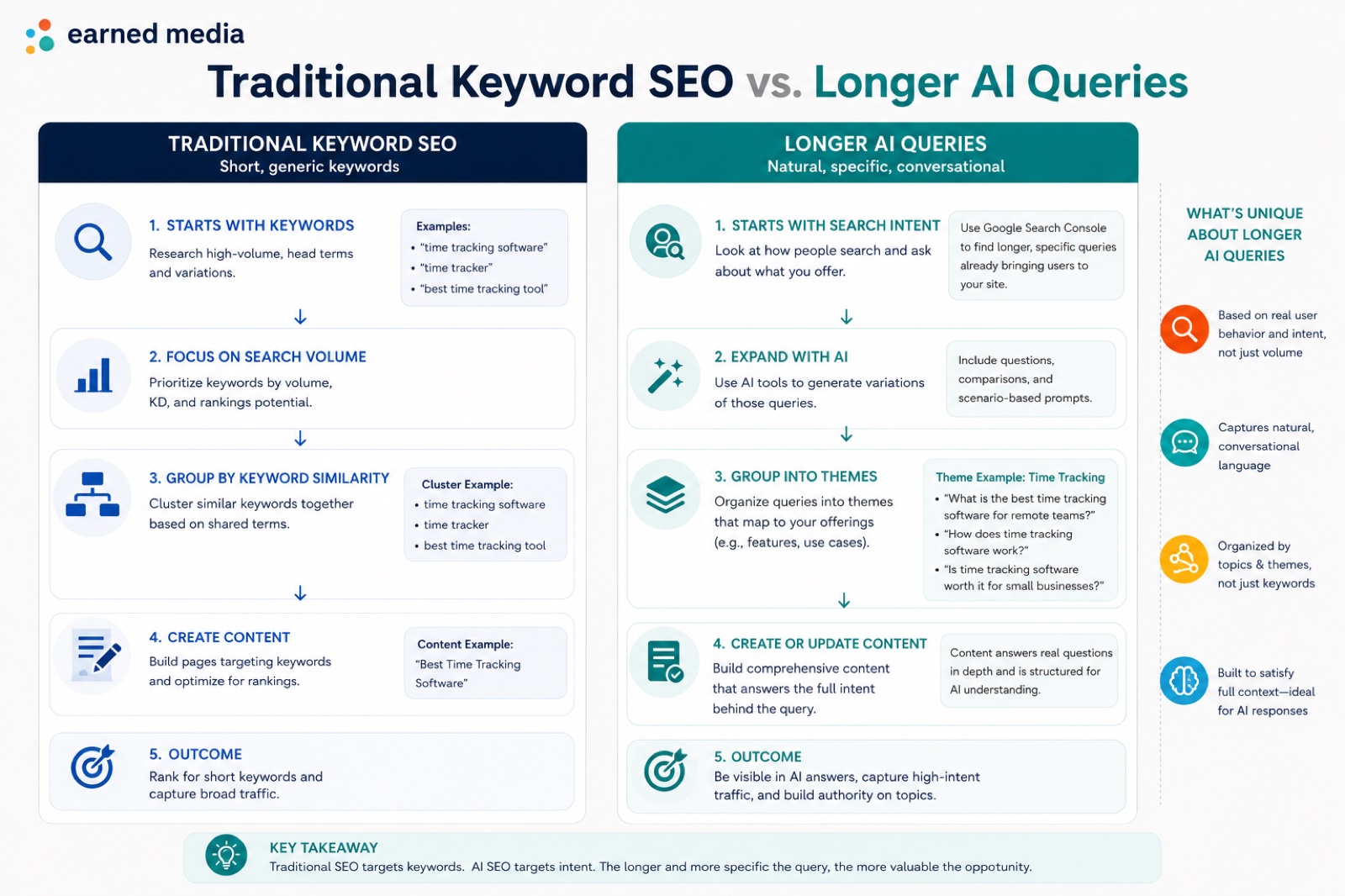
Once you have a large set of queries, the next step is grouping them into themes. This is where structure starts to form. For example, if you're selling software, those groups might align with the features you offer. This would look like the following:
Time tracking
- "What is the best time tracking software for remote teams?"
- "How does time tracking software work?"
- "Is time tracking software worth it for small businesses?"
This process helps you move from a scattered list of queries to clear topic clusters. Those clusters then guide what content you need to create or update.
Content optimisation
Once you have ordered the queries, you need to create or update your content to match them directly.
AI systems make an early decision on whether a page is useful. If the answer is not clear within the first part of the page, it is unlikely to be used. That is why each page should open by directly answering the core question it targets.
From there, structure the page so it can be easily broken into sections. Each section should answer a variation of the query.
Instead of writing one page for one keyword, you are building coverage across a topic. This is what allows your content to show up across multiple prompts.
Site structure
Much like with traditional SEO, the technical side of your website can determine whether your content is even considered. AI systems still rely on being able to crawl and retrieve your pages. If your site is not indexed properly or if the content is difficult to access, it will not be part of the pool of sources.
Clean site structure, internal linking, and basic schema help ensure your content can be found and interpreted.
Field note · Information architecture
Anatomy of a well-structured site
A simple parent → child hierarchy: one home page, two top-level categories, subcategories beneath each, and sub-subcategories where the topic warrants extra depth. The same shape an LLM walks when it tries to understand what your site is about.
-
Home
Home page
/ — top of the hierarchy
-
CategoryCategory A
- SubcategorySubcategory A1
- SubcategorySubcategory A2
-
CategoryCategory B
-
SubcategorySubcategory B1
- Sub-subcategorySub-subcategory B1a
- Sub-subcategorySub-subcategory B1b
- SubcategorySubcategory B2
-
SubcategorySubcategory B1
-
CategoryCategory A
Diagram by Earned Media · Originally published in The Complete Guide to GEO and AI SEO
Entity optimisation
AI systems build an understanding of your business by connecting information across sources. If it is described differently in different places, this makes it harder to interpret and reference for AI. To fix this, your positioning, services, and audience should be defined once, then repeated consistently everywhere your business appears.
Third-party authority
AI models compare multiple sources before deciding what to include, which means your brand needs to show up beyond your own content.
This is where link building and digital PR play a role. Getting your brand mentioned in articles, industry roundups, news coverage, or even on your competitors' sites (yes, we have made this happen for clients) does two powerful things. It creates more surfaces for AI systems to find and understand your business, and it reinforces that your brand is recognised by other sources.
Measuring success
Start with your analytics. In GA4, check your referral traffic and look for sources like ChatGPT or Gemini. Even small volumes show your content is being picked up. From there, review engagement and conversion rates to see how these users move through the funnel.
Next, test your priority prompts manually. Search them across AI platforms and track whether your brand appears, how it's described, and which competitors are included.
Finally, check the attribution paths report in GA4. This is where you'll start to see how LLMs have been influencing conversions.
Since AI-driven discovery often happens earlier in the journey, a user might first find you through an AI answer, then return later via direct or branded search to convert. If you're seeing AI referrals appear before a conversion, that's a strong signal that your visibility is impacting commercial outcomes.
What tools and metrics can you use to measure AI visibility?
AI search can feel opaque, especially compared to all the rich data we used to get from Google. Now it's about piecing together visibility from multiple signals. Here's what brands are measuring and the tools they are using to help understand the impact of their AI search work.
Rather than relying on one metric, we recommend you analyse a set that reflects how AI surfaces your brand.
The AI metrics you can measure and why they matter
| Metric | What it shows | Why it matters | Where to find it |
|---|---|---|---|
| Referral traffic (sessions by source/medium) | Visits from LLM sources | Confirms your content is being picked up and surfaced in AI answers | GA4 |
| Conversions from AI traffic | Conversions attributed to those referral sources | Shows whether AI visibility is driving commercial outcomes | GA4 |
| Prompt visibility | Whether you appear for key queries | Tracks coverage across real user questions | EMintel, Semrush |
| Sentiment | How AI describes your brand (positive, neutral, negative) | Impacts users' perception of your brand | Hall, Semrush |
| Share of voice (AI) | Percentage of total AI mentions your brand owns vs. competitors | The closest equivalent to "ranking" | EMintel, Semrush |
| AI overview coverage | Number of queries where your site appears in Google AI overviews | Shows whether you are visible inside Google's AI-generated results | Semrush |
| Mention rate (per prompt set) | Percentage of tracked prompts where your brand is mentioned | Indicates how consistently you appear across high-intent queries | EMintel |
I'd recommend tracking a few of these metrics together rather than in isolation, as this gives you a more real-time view of your impact across AI search.
The must-have tools for GEO and AI search
Tracking AI visibility is still messy, and most brands don't have a clear view yet. However, at Earned Media, we are finding that the teams that invest in tools to measure and refine this process early are the ones that are pulling ahead.
Here are the top three tools I'd recommend for businesses wanting to take on AI search and quantify their efforts.
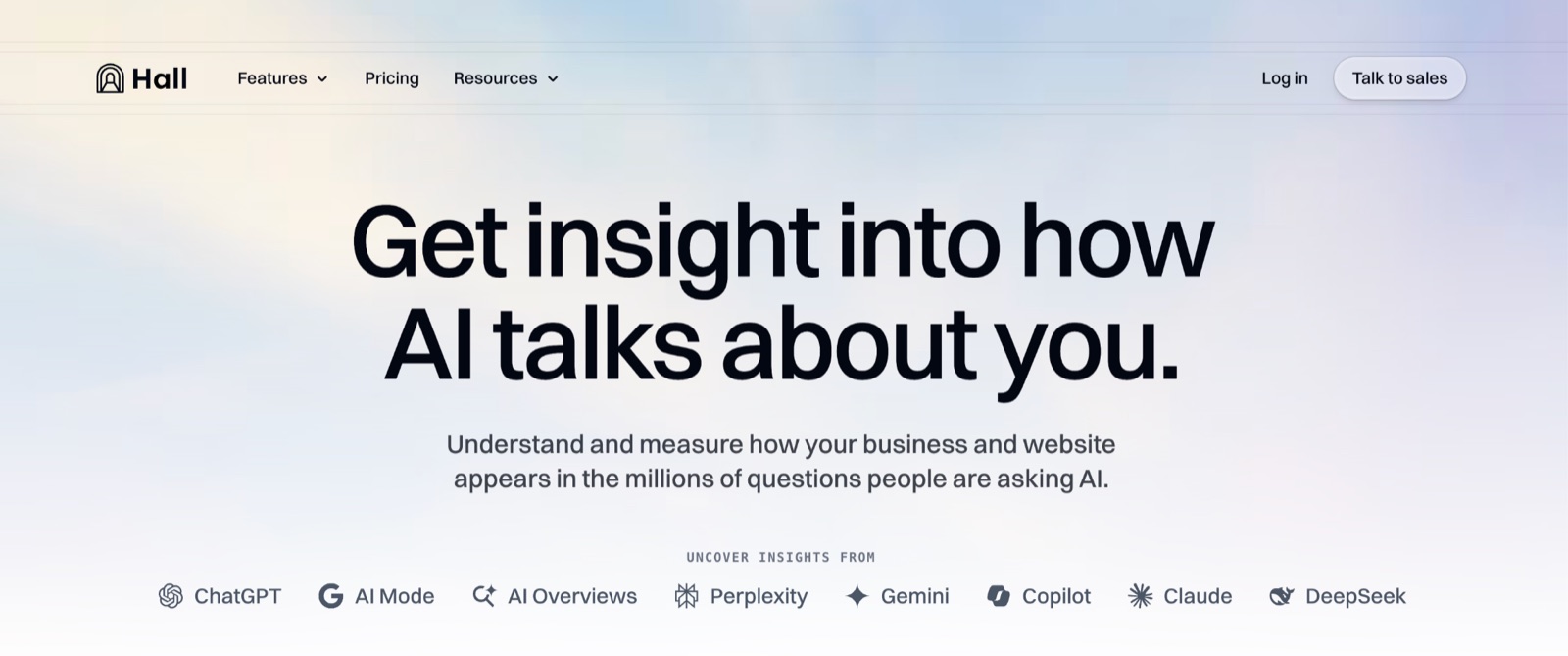
Hall
Hall gives you a live view into how your brand appears across AI-generated answers at scale. It shows which pages are being cited and how your brand is positioned within responses across different platforms.
"Every major technology shift creates a new channel for businesses to reach their customers — the web unlocked search, mobile unlocked social, and now AI is unlocking something entirely new. People are skipping Google and going straight to ChatGPT, Perplexity, and Gemini to make purchasing decisions, and the brands showing up in those answers are the ones winning. We built Hall to give companies the visibility and tools to understand how they're represented in AI conversations, measure their share of voice, and optimise their presence in what we believe is the most important new channel in a generation."
— Kai Forsyth, Founder at HallWhat makes it different is that it also tracks how AI agents and crawlers interact with your site, which helps explain why certain content is being pulled into answers, and other content is not.
Semrush
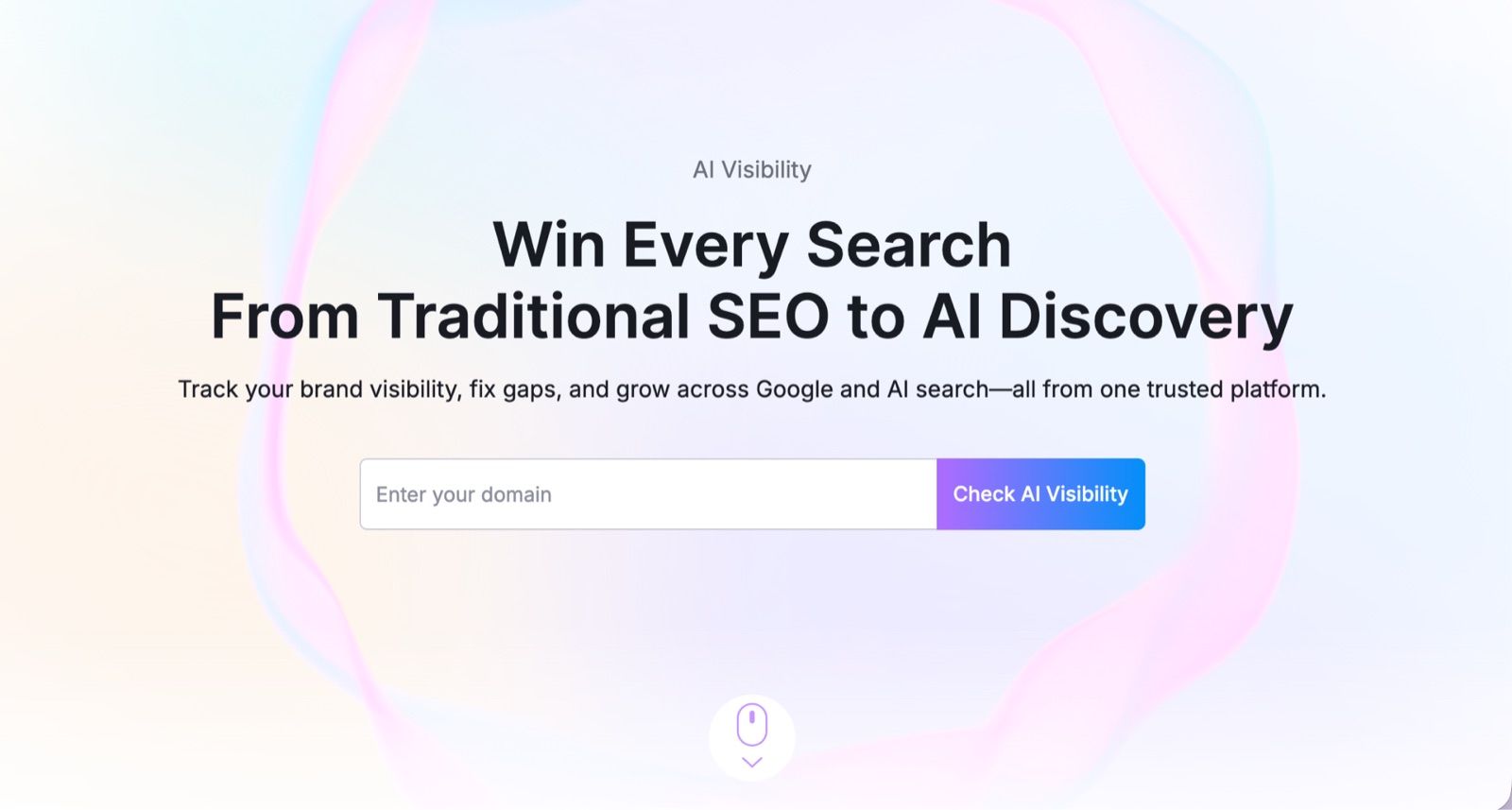
Semrush's AI Visibility Toolkit brings structure to AI search by making it measurable over time. It tracks visibility score, share of voice, and prompt coverage while showing where competitors are appearing instead of you. This makes it easier to identify gaps in your strategy and track progress.
EMintel
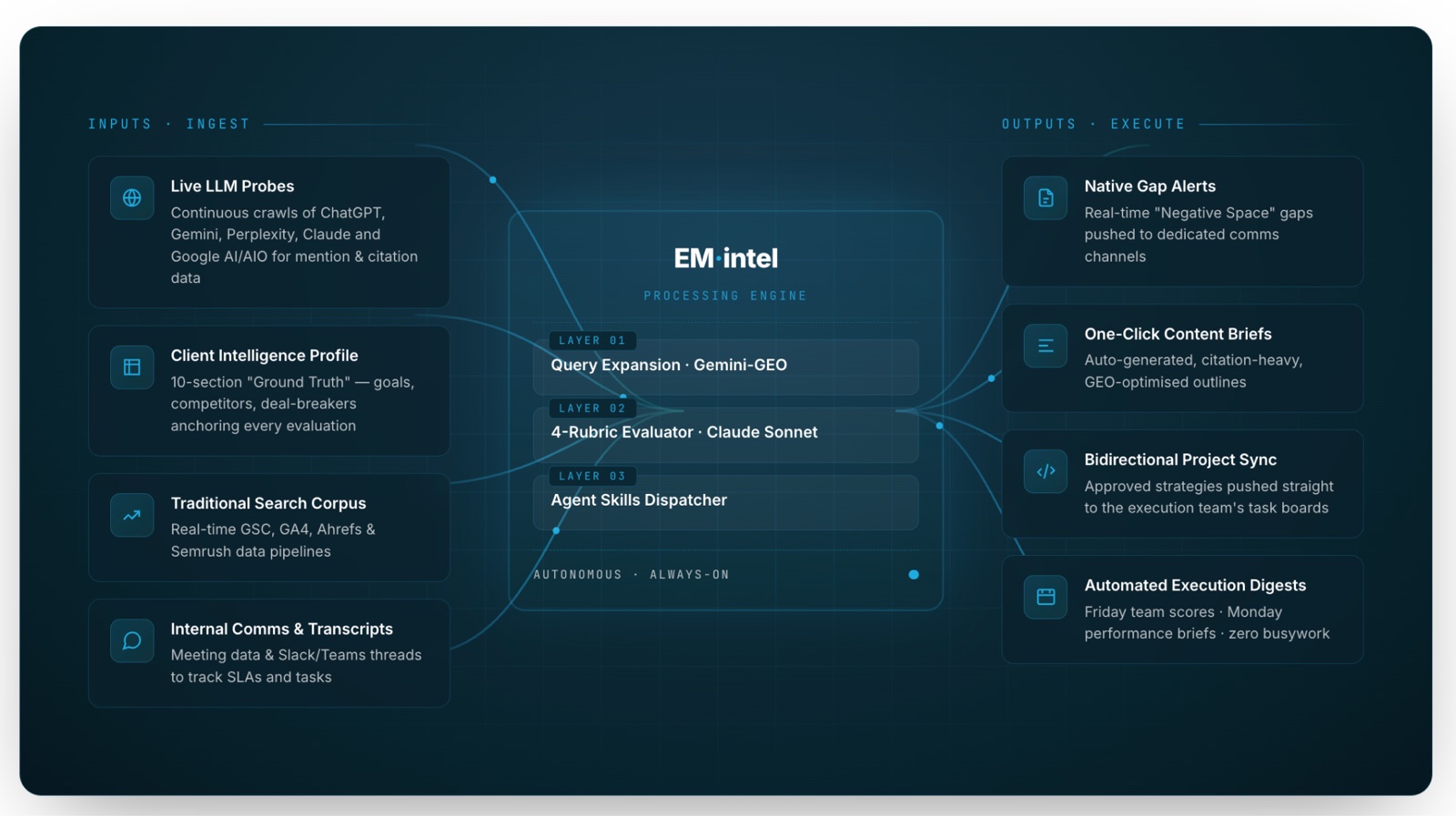
Earned Media's EMintel is designed to help your team move from simple insights to action. It combines your data from GA4, Search Console, and live LLM probes to evaluate how your brand performs across key queries.
"The traffic LLMs are sending now is the highest-quality commercial traffic we've ever seen — buyers arrive having spent twenty minutes inside an AI comparing options, ready to buy on the first visit. Converts roughly twenty times better than anything else. Which is exactly why Negative Space matters so much: every commercial query an AI answers without naming your brand is a buyer you're not even in the consideration set for. EMintel surfaces those queries, shows you which competitors are getting cited instead, and gives you the operational roadmap to close the gap. You can't compete for buyers you're invisible to."
— Nick Brogden, GM & Chief Strategist, Earned MediaIt then, using their priority tools such as Negative Space, identifies where you are being excluded or misrepresented, and turns that into clear actions across content, authority, and technical areas. This helps you improve your visibility in a targeted way.
How to run a GEO and AI search audit
This is part of our process at Earned Media. We map how brands appear across AI-generated answers, identify where visibility is missing, and pinpoint what needs to change to close those gaps. Here's how you can do your own AI search audit.
1. Identify your priority AI search prompts
Start by listing the top prompts your buyers would realistically use. You can pull these directly from Search Console, sales conversations, and by asking AI tools to generate variations.
For this process, I think in scenarios, not keywords. For example, if you run a physiotherapy clinic, someone might ask: "Who is the best physio near me for a running injury?" or "Where can I get a sports massage for a neck injury in Melbourne this week?"
I'd also try to include some task-based prompts. This is where someone is asking an AI tool to compare options or suggest what to do next.
2. Run those prompts across AI platforms
Next, I manually test those prompts across platforms like Google AI Overviews, ChatGPT Search, Perplexity, Gemini, and Copilot. For each one, document if your brand appears. If it is included, assess how it is described and which competitors or alternatives are being recommended.
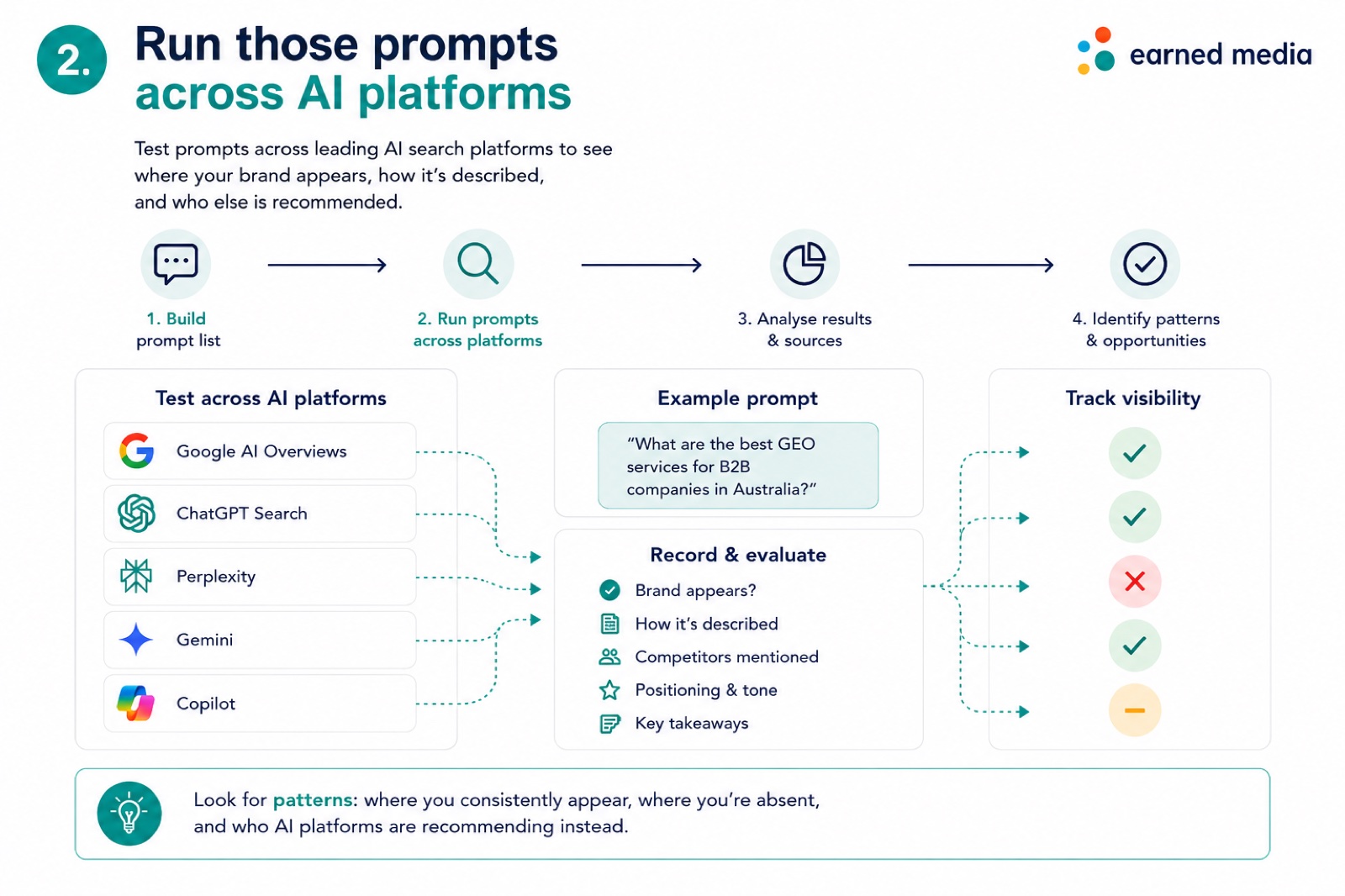
As you go through the platforms, you'll start to see patterns. There might be prompts where you consistently appear, while in others, you're completely absent.
3. Look at what AI is using as sources
Once you've reviewed the answers, analyse the sources AI systems are relying on to generate them. These may include your own website, competitor pages, review platforms, directories, news coverage, LinkedIn profiles, YouTube transcripts, forums, and industry reports.
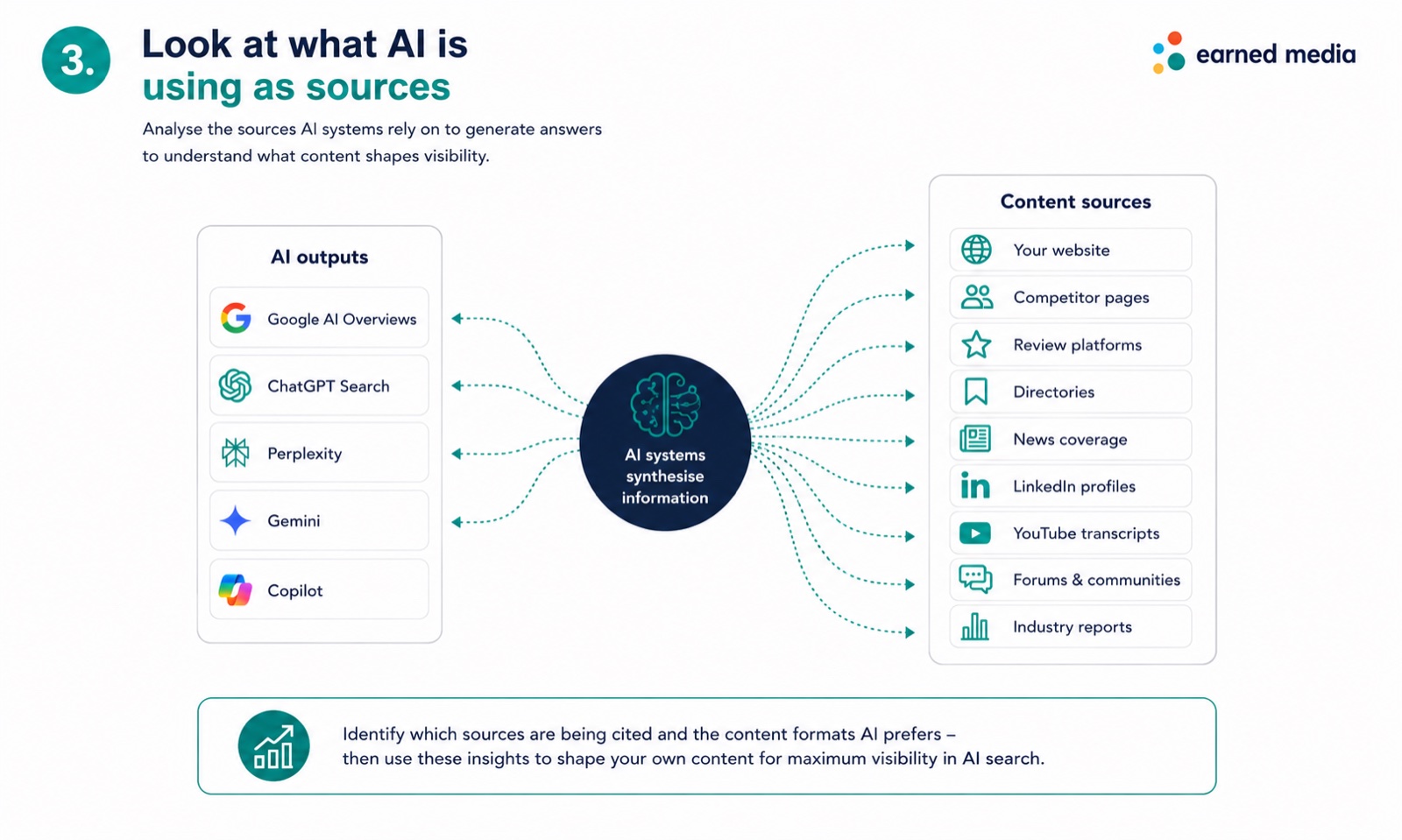
You'll usually start noticing patterns in the content being referenced. Pages that perform well in AI search are often highly structured, answer questions directly, use clear headings, and align closely with search intent. They also tend to reinforce credibility through examples, supporting evidence, or third-party mentions.
This helps define what "good" looks like in this environment. You can use that to shape your own pages, so they present information in a way that AI systems like to include.
4. Find content gaps
Once you've reviewed the answers and sources, the next step is to identify why your competitors are being included instead of you.
In some cases, the issue is content. You may not have pages answering important questions, or your existing content may be too broad, outdated, or unclear for AI systems to extract from.
In other cases, the issue is authority. AI systems compare multiple sources before deciding what to include, so brands with stronger trust signals across the web are often referenced more frequently. This includes things like digital PR, reviews, backlinks, media coverage, and mentions on trusted industry websites.
5. Check for technical issues
As with traditional SEO, AI systems still need access to interpret your content properly, so the next step is reviewing whether technical issues are limiting your visibility.
A Semrush study analysing five million URLs cited by ChatGPT Search and Google AI Mode found that AI systems were more likely to reference pages with strong site structure and schema markup.
Start by checking whether your important pages are indexed in Google by searching for them or reviewing traffic in GA4. From there, look for crawlability issues, noindex tags, broken links, or internal linking problems that could be preventing content from being discovered.
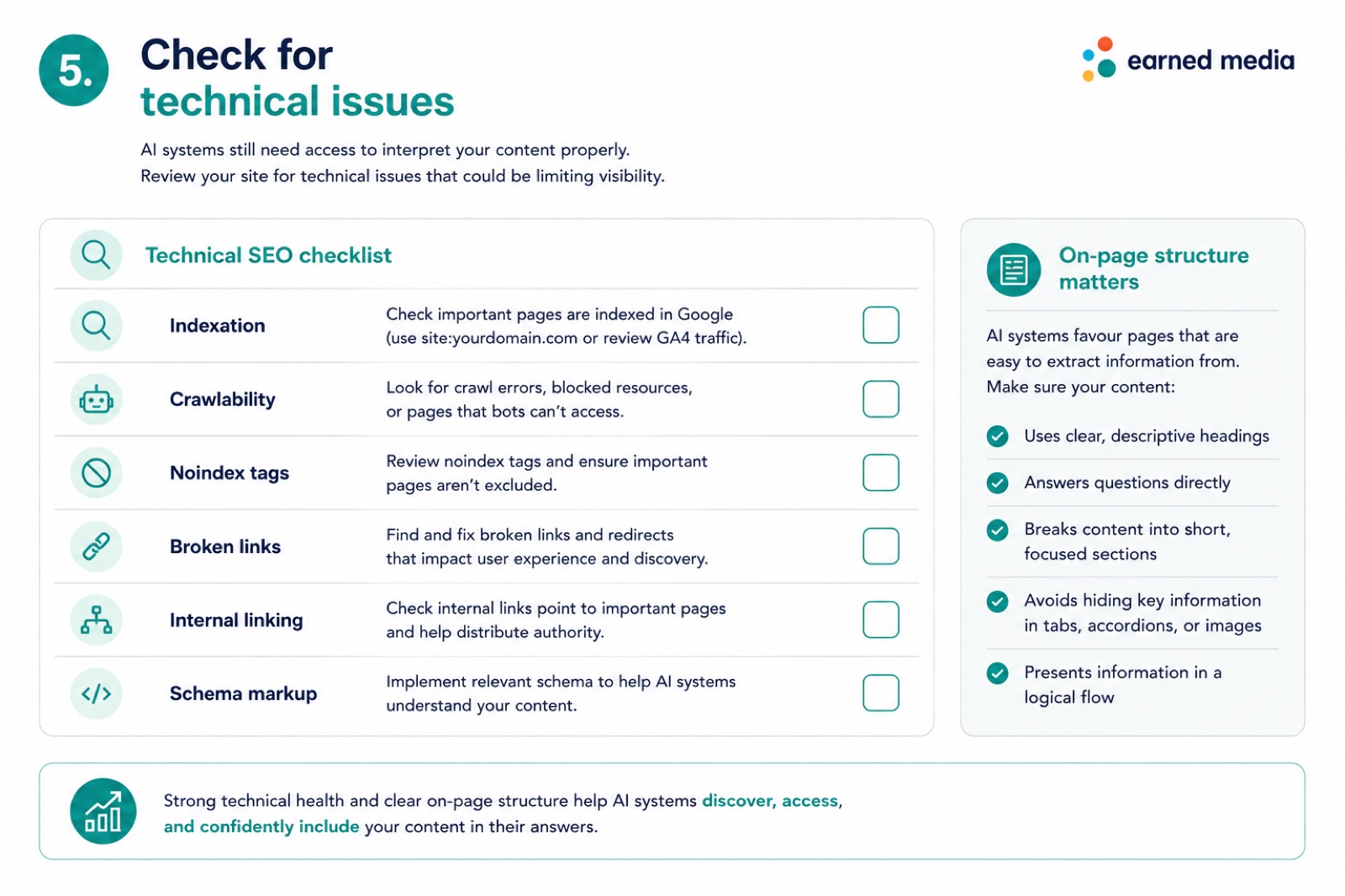
You should also review how your content is structured on-page. AI systems favour pages that are easy to extract information from, with clear headings, short sections, and direct answers. Make sure you don't have key information hidden inside tabs, accordions, or on images, as it hides this content from AI search systems.
6. Prioritise your next steps by commercial value
The final stage of the audit is deciding what to act on first. I'd recommend starting with high-intent prompts first, as these are the searches most likely to lead to conversions. This includes prompts about comparing providers, researching pricing, or looking for the best option within a category.
Once your audit is complete, the next step is prioritising a small group of high-value prompts to optimise for. From there, create or improve content around those queries, make the necessary technical or authority updates, and track how your visibility changes over time.
If you're curious about how AI is citing your content and where your gaps are, you can receive a no-commitment, free audit from Earned Media's GEO experts.
Claim your free AI search audit →
Tips to get your content referenced by AI
Now that you've completed your audit and have a clear list of content gaps to fill, I'd like to take a look at some ways you can make your content easier for AI systems to understand and reference.
Here are Earned Media's tips for the most effective ways to improve your chances of being cited within AI-generated answers.
Structure your content for AI extraction
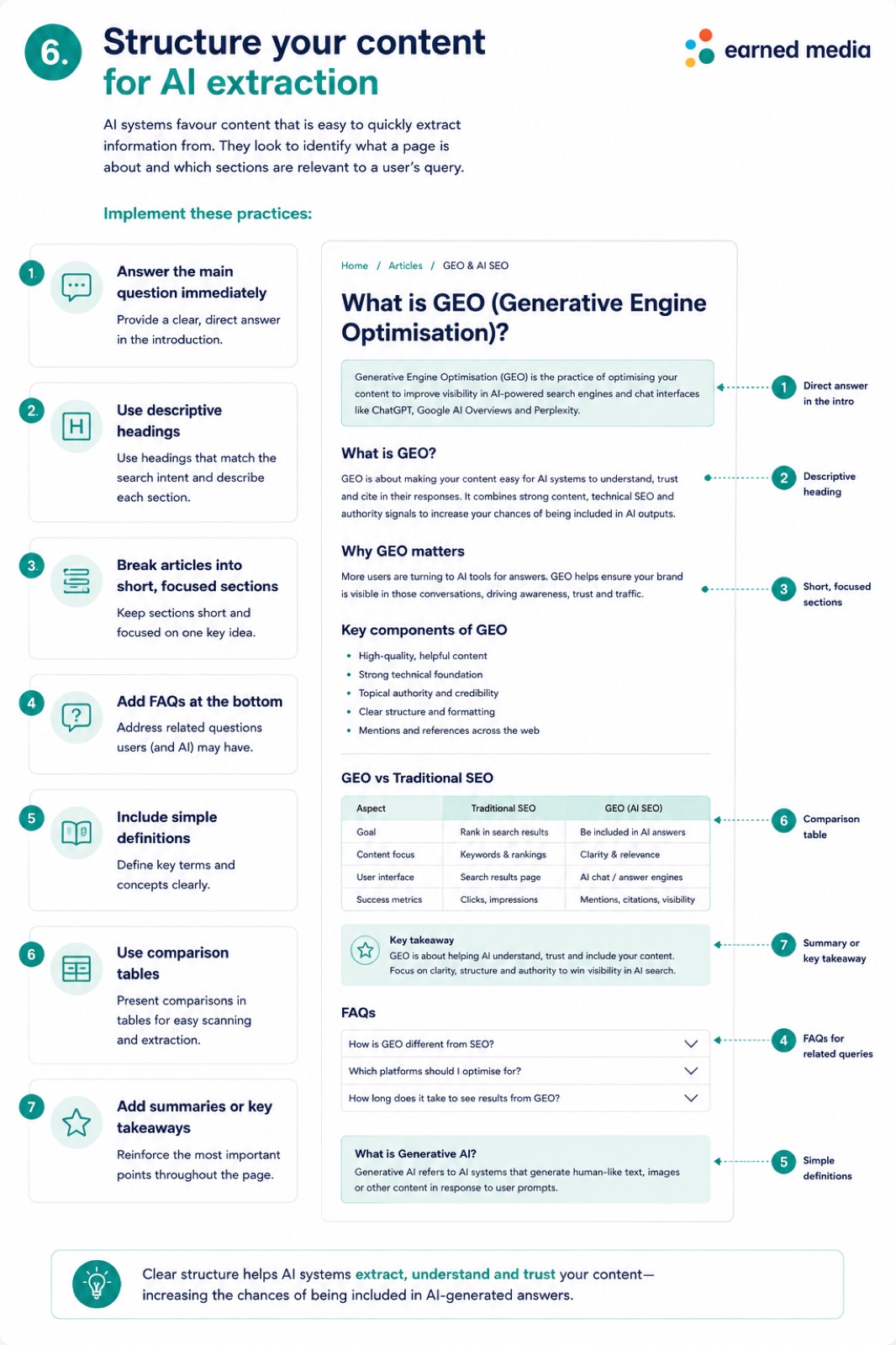
At Earned Media, we find that AI systems favour content that is easy to quickly extract information from. AI models are looking to identify what a page is about and which sections are relevant to a user's query.
To do this, try implementing the following practices:
- Answer the main question immediately in the introduction
- Use descriptive headings that match the search intent
- Break articles into short and focused sections
- Add some FAQs at the bottom to cover related queries
- Include simple definitions for important concepts
- Use comparison tables for products or services
- Add summaries or key takeaways throughout the page
Build trust signals to appeal to AI
AI systems compare multiple sources before deciding what to include, so content that appears credible and well-supported is more likely to be referenced.
To achieve this, experiment with doing the following:
- Include expert quotes and commentary (this could be from your internal experts)
- Reference credible studies and statistics
- Add examples or case studies
- Showcase the author's expertise (mention their years of experience and field)
- Build backlinks from trusted industry websites (start with review sites)
- Invest in digital PR and media mentions
- Keep your business positioning consistent across platforms
Creating original content that AI can't find elsewhere
AI systems already have access to thousands of pages covering the same topics, so content that contributes something original is more likely to get referenced. This is often referred to as "information gain".
To do this, try adding the following to your content:
- Publish original data from self-run studies
- Include expert perspectives or commentary
- Share internal benchmarks or perspectives
- Create unique frameworks or methodologies
- Share opinions on emerging trends or recent developments
It's also worth noting that human-created content is still king, and far more likely to grab an AI system's attention than AI-generated content.
Use multimedia in your content
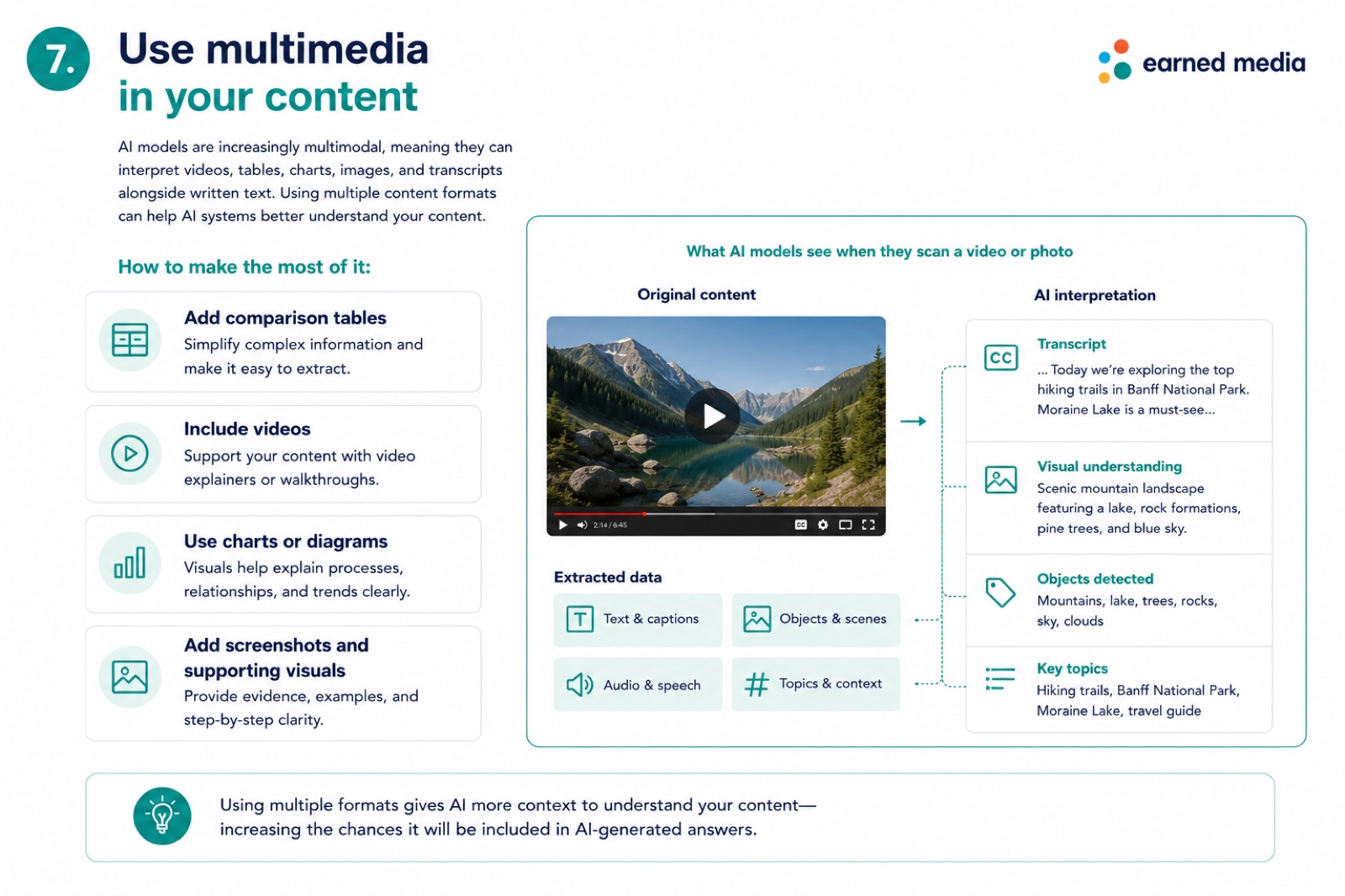
AI models are increasingly multimodal, meaning they can interpret videos, tables, charts, images, and transcripts alongside written text. Using multiple content formats can help AI systems better understand your content.
Here are things you can do to make the most of this:
- Add comparison tables to simplify information
- Include videos to support your content
- Use charts or diagrams to explain processes
- Add screenshots and supporting visuals
Covering topics comprehensively
Strong GEO content needs to cover a topic broadly rather than focusing on one keyword alone. If you can do this, it increases your chances of appearing across different query variations.
Some practical ways to approach this include:
- Include related questions throughout the page
- Cover comparisons
- Add scenario-based examples
- Connect related pages with internal links
- Update content regularly as information evolves
The future of search belongs to the brands that move quickly
AI search has changed how potential customers discover businesses. As more people adopt platforms like ChatGPT and Google AI Overviews, brands will need to start thinking about their GEO strategy and how they'll get mentioned across AI-generated answers to remain competitive.
At Earned Media, we help businesses in Australia and globally improve their visibility across modern search platforms through technical optimisation, link building, and search-focused content creation.
Our purpose-built software tool EMintel also helps businesses track how they are appearing across AI-generated answers and identify what next steps they can take.
If you want to understand how your brand currently performs across AI search, reach out to our team for a free AI search audit.
FAQs
Is GEO better than SEO?
At Earned Media, our GEO strategy builds on top of traditional SEO. SEO still matters because AI systems rely on many of the same technical and content foundations. However, GEO requires a different strategy focused specifically on improving how your brand is referenced by AI.
What are some common mistakes people make with GEO?
A common mistake is treating GEO exactly the same as traditional SEO. Many brands focus too heavily on keywords while overlooking things like structure, authority, and creating original insights.
Can SEO be done using AI?
Reviewing how your brand is mentioned in AI can help inform your strategy. However, GEO strategies still rely on human input, original insights, technical optimisation, and content that adds genuine value.
How can you do AI SEO for local businesses?
Local businesses should focus on consistent business information, strong reviews, directory listings, and content targeting conversational local searches like "the best vet in Sydney for pet rabbits."
Are there marketing agencies in Australia that can help with AI SEO?
Yes, Earned Media is an Australia-based agency helping brands improve their visibility across AI platforms. They also built EMintel, a proprietary platform designed to track prompt visibility and monitor how brands appear within generated search responses.