This is an AI SEO case study and an LLM success story. A $50 imitation was quietly bleeding Tummy Shield's funnel — being recommended by AI as the budget alternative to Australia's only crash-tested pregnancy seatbelt, while the real product was being framed as expensive and optional. Today, that's reversed. Google AI Overviews, AI Mode and Gemini now describe Tummy Shield as the proven-safe choice and the cheap copy as the risk. Here's exactly how we did it, and what it means if AI is currently telling the wrong story about your brand.
The sentiment problem
Tummy Shield is a heavy-duty pregnancy seatbelt positioner. Engineered stainless-steel core anchor plate, crash-tested at CrashLab Sydney to Australian Design Rules 4/03 and 5/04 parameters. It is, by any honest reading of the evidence, the only proven-safe aftermarket pregnancy seatbelt sold in Australia.
The Mimi Belt is a $50 hook-and-strap adjuster. Independent crash testing by ADAC in Europe found that cheap adjusters of this style increase abdominal and pelvic force by up to 30% in a collision. It has no recognised crash tests and no ADR compliance behind it.
Despite that, the Mimi Belt was the answer AI was giving. When an expectant parent asked ChatGPT, Gemini, Google AI Mode or AI Overviews about pregnancy seatbelt safety, the Mimi Belt was framed as the affordable, sensible option. Tummy Shield, when mentioned at all, was framed as the expensive premium choice — a comparison that implies a like-for-like swap, which is exactly the framing Mimi Belt's marketing benefits from.
That sentiment problem was real money. The owner of Tummy Shield, Josh Fischer, said it directly: "Mimi Belt was quietly bleeding our entire funnel — we were paying to create demand and losing it to a cheaper, unsafe copy." Brand search traffic was being intercepted. Ad spend was generating demand that converted at the competitor. AI was making the introduction at the exact moment of decision, and making it for the wrong product.
Why AI sentiment moves money
In categories where buyers check four or five sources before they spend, AI is now one of those sources — often the first one. That's especially true in safety, health and parenting categories, where the research is intense and the stakes are high.
When AI gives a confident answer that frames your competitor as the obvious budget choice, three things happen at once. Your branded search traffic gets intercepted. Your paid demand gets siphoned. Your sales conversations start with a comparison you didn't agree to.
That is the AI sentiment problem in plain terms. It is not abstract. It shows up on the P&L. And in Tummy Shield's case, it was reversing the natural advantage of having the only product in the category that had actually been crash-tested.
The play: change the answer
The instinct in this situation is to fight on price or shout louder. Both lose. The cheap copy will always be cheaper. The advertising volume game gets expensive fast.
The play was different: don't fight on price, change the answer. If we couldn't stop parents researching, we'd own what they found. Three integrated workstreams under one strategy.
Own the answer. Create the single most authoritative, source-backed page on pregnancy seatbelt safety in Australia. Built to be cited, not just read. Structured for AI Overviews and LLM citation: clear named claims, sourced evidence, scannable hierarchy, no fluff.
Discredit the copy. Surface the independent evidence — ADAC crash testing, ADR compliance frameworks, the absence of recognised certification behind the rival — so the cheap option reads as the unsafe choice, not the sensible one.
Earn the validation. Win third-party coverage from outlets that AI treats as authoritative. Make the safety story unavoidable in the citation graph that LLMs and search engines learn from.
The cornerstone built to be cited
The asset was a single piece: "Tummy Shield: The Safety Innovation For Pregnant Women On The Road", published November 2025. It is engineered to win the argument.
Every claim is anchored to a named source — ADAC crash testing, CrashLab Sydney, ADR 4/03 and 5/04. Every paragraph is chunked so an LLM can lift it into an answer without context loss. Every key entity is named explicitly — "Tummy Shield" rather than "we" or "the product" — so the LLM has something to attach the safety claim to. That's the chunking and brand-entity discipline we've been writing about in how to write SEO content that AI cites, applied at scale to one cornerstone page.
Over a 16-month Google Search Console window to June 2026, that single page hit a 4.6 average position, a 0.98% click rate (beating the site's larger blog pages), and earned roughly 49,500 impressions across the .com and /en-au versions. It is still compounding.
The PR that fed the citation graph
The page alone isn't enough. LLMs and AI Overviews don't just read the page — they read what the rest of the web says about the topic, and they weight independent third-party sources heavily. So we took the evidence to two audiences.
First, the mummy-blog network — the trusted Australian parenting publishers that expectant mums actually read. Buggybuddys (Perth), Beanstalk Mums, Eastern Suburbs Mums, Kids on the Coast. Genuine brand mentions inside safety and wellbeing content, where parents already trust the publisher.
Second, a national motoring authority. Drive.com.au ran an independent consumer-warning feature: "Use extreme caution: the unregulated car accessory pregnant women are being duped into buying." That single placement put a safety warning in front of a mainstream national audience and dropped a strongly-worded, independently-sourced citation into the same crawl set the LLMs read.
Plus a brand mention inside Wikipedia's National Child Passenger Safety Board page — one of the most heavily-weighted knowledge resources in the AI training corpus.
What the AI says now
The result is the story flipping in the surfaces that matter. Today, when a parent researches their options:
- Google AI Mode answering "is the Mimi Belt safe?" opens with: "No, the Mimi Belt is not considered safe by automotive safety experts, transportation authorities, and independent consumer advocacy groups." Tummy Shield is cited inline as the proven safe alternative.
- Google AI Overviews on the "mimi belt" query carries a "subject of significant debate" framing, with safety and regulatory concerns surfaced before any product detail.
- Google AI Mode answering "best seatbelt option for pregnant woman" recommends a correctly-adjusted three-point seatbelt as the gold standard, and names Tummy Shield as the only compliance-tested premium alternative for parents who need an aftermarket positioner.
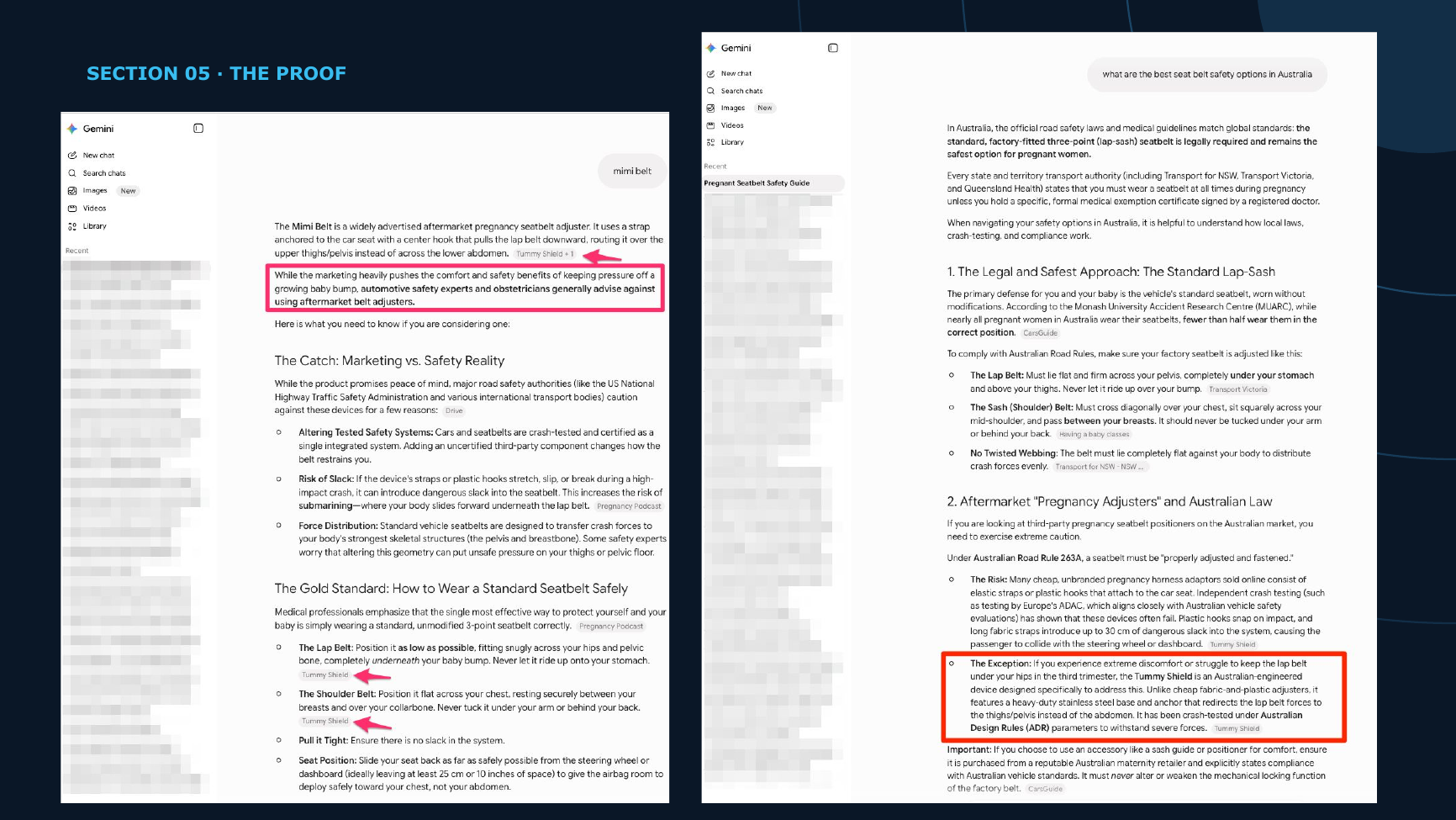
- Gemini on the "best seat belt safety options in Australia" query names Tummy Shield as "an Australian-engineered device... It has been crash-tested under Australian Design Rules (ADR) parameters to withstand severe forces."
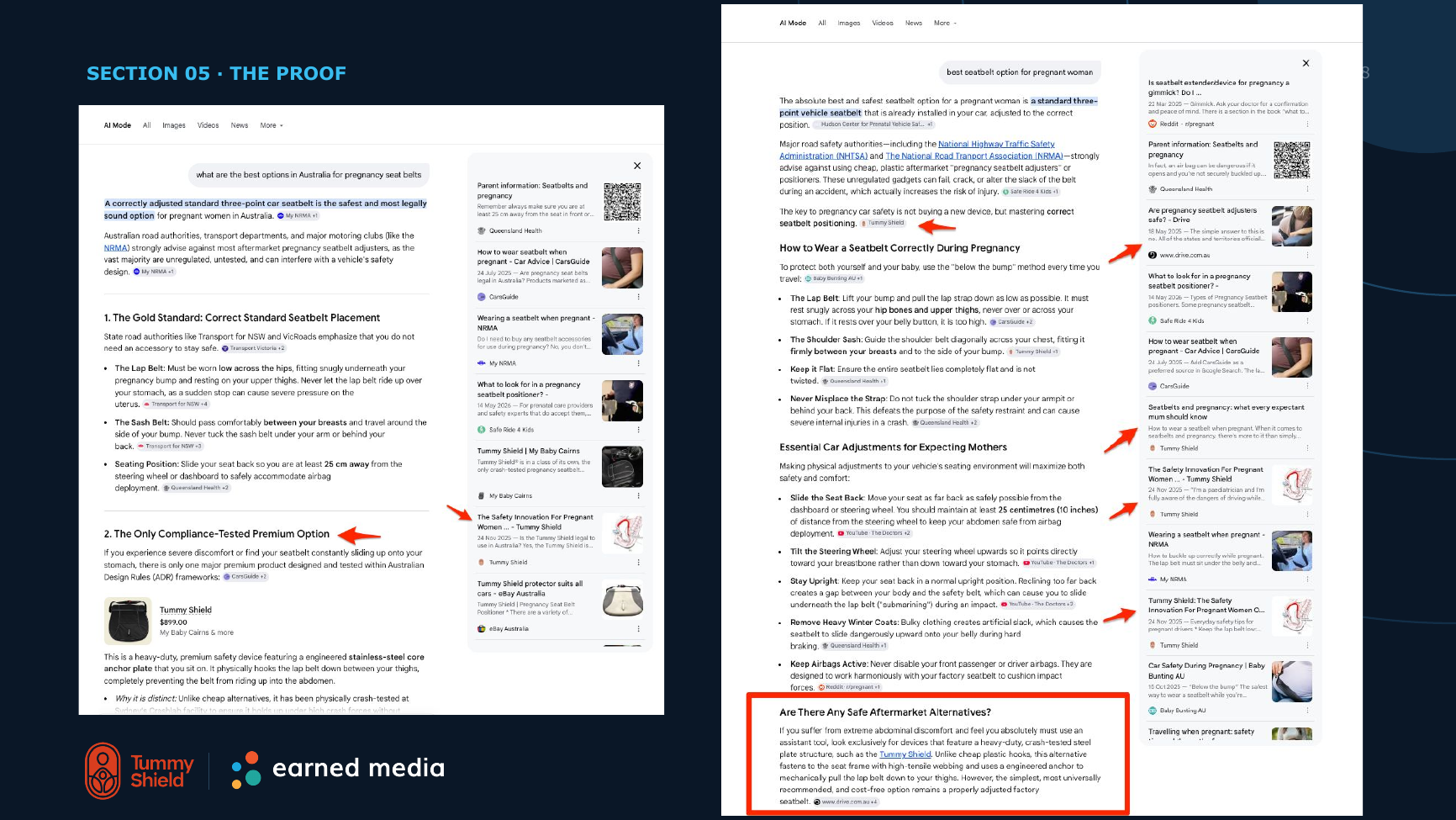
This is the inversion. The sentiment that was costing Tummy Shield sales has flipped to defending them. The cheap copy now reads as the risk; the proven-safe option reads as the answer. And the AI is doing that work at the exact moment the parent is deciding what to buy.
The numbers
Over the 16-month Google Search Console window to June 2026:
- #4–5 ranking on the Mimi Belt brand search. Tummy Shield content now intercepts the rival's own branded query with the safety truth.
- Site-wide search impressions roughly doubled across the campaign window — from approximately 35,000 to 85,000 per month — as authority and content footprint compounded.
- Category-wide average position strengthened from 6.5 to 4.8, consistent with broader brand authority gains rather than a single-page outcome.
- Cited across Google AI Overviews, AI Mode and Gemini for pregnancy seatbelt safety queries and for the rival's own brand search.
- Independent third-party coverage across Drive.com.au, four mummy-blog publications, and a Wikipedia knowledge-resource mention.
The owner's view, in his own words: "Earned Media flipped that. Now when a parent researches their options, the answer points to us as the only proven-safe choice, and even the AI tools recommend us. It lifted ROI across every channel we run." — Josh Fischer, Owner, Tummy Shield · Founder & former COO, Camplify (ASX: CHL).
The full breakdown — every stat, every outlet, every screenshot of the AI surfaces — is in the Tummy Shield LLM Optimisation Case Study.
What this means for any brand worried about AI sentiment
The Tummy Shield play is a repeatable model, not a one-off. If AI is currently telling the wrong story about your brand — recommending the wrong competitor, framing your product in a way that doesn't match the evidence, or just leaving you out of the answer entirely — the same four moves apply.
Find out what AI actually says. Run the queries your buyers actually ask, across every platform that matters. ChatGPT, Gemini, Perplexity, Claude, Google AI Overviews, Google AI Mode. Score where you're present, where you're absent, where you're framed badly, and where a competitor is being recommended in your place. This is the work we built Negative Space to do at scale.
Find the sentiment gap. An absence is one problem. A sentiment problem is bigger. If AI is naming you and framing you wrong, the lift to fix that is different to the lift to claim empty territory.
Build the cornerstone. One source-backed page that the AI cannot honestly write around. Named claims, named entities, independent evidence, structured for citation. Not fifteen pieces of optimised content — one piece of evidence.
Earn the validation. Coverage from sources the AI trusts — third-party publishers, motoring authorities, knowledge resources like Wikipedia where the topic is relevant. The citation graph is what tilts the LLM's answer; the cornerstone alone won't.
That is what an AI SEO Agency should actually deliver. Not just rankings. The story the AI tells about your brand — and the sentiment behind it.
Want a read on what AI says about you right now? Request a free Truth Gap audit. We run your buyers' deal-breaker questions across the major AI models and show you exactly where the sentiment, the framing or the absence is costing you money.